


[Aug-2026] PMI-ACP Braindumps – PMI-ACP Questions to Get Better Grades
PMI-ACP Exam Dumps - Try Best PMI-ACP Exam Questions - VCE4Dumps
To be eligible to take the PMI-ACP certification exam, candidates must meet certain prerequisites, including a minimum of 2,000 hours of project management experience, 1,500 hours of experience working on agile projects, and 21 hours of training in agile practices. Once a candidate has passed the certification exam, they will be awarded the PMI-ACP certification, which is recognized globally and is highly valued by employers. PMI Agile Certified Practitioner certification is also subject to ongoing maintenance requirements, ensuring that certified professionals remain up-to-date with the latest developments in agile project management.
NEW QUESTION # 46
During an executive review, a scrum master uses a burndown chart to demonstrate team deliverables through time. The scrum master declared that velocity increased from 27 to 35 over the last 3 sprints, but one of the executives asks to clarify the importance of these metrics.
How should the scrum master respond?
- A. Project velocity should be stable overtime.
- B. Velocity is iterative and will only be used for sprint numbers.
- C. A burndown chart compares planned versus actual, not velocity.
- D. Moving velocity from 27 to 35 is a decrease in productivity.
Answer: A
Explanation:
Velocity is a measure of the amount of work a team can handle during a sprint, typically measured in story points. While it can fluctuate slightly from sprint to sprint, the goal is to have velocity stabilize over time, as this helps in forecasting future sprints and planning. An increase in velocity from 27 to 35 could indicate an improvement in the team's capacity to deliver, which should be celebrated if it aligns with the team's capabilities. However, a stable velocity over time is what typically matters for predictability and planning.
NEW QUESTION # 47
A product owner asks a newly formed scrum team how many story points will be completed in a sprint.
What should the scrum master do?
- A. Average the sprint velocity based on input from team members
- B. Engage the team to determine the sprint velocity based on previous agile projects
- C. Run multiple sprints before determining the sprint velocity with the team
- D. Share the sprint velocity obtained from the sponsor with the team
Answer: A
NEW QUESTION # 48
What information should a project team include in an extended stakeholder report to ensure that all current and future stakeholders are aware of the frequent updates?
- A. A list of tools used for implementation
- B. A list of open technical issues
- C. Team capacity and competence profiles
- D. Up-to-date project radiators
Answer: D
Explanation:
The correct answer is D - Up-to-date project radiators.
Information radiators provide at-a-glance visibility into project status, progress, blockers, and other key metrics. Sharing or including these visual tools in extended stakeholder communication ensures transparency and up-to-date awareness, which aligns with agile values.
PMI Agile Practice Guide:
"Information radiators provide immediate and transparent access to project health and status. They reduce the need for formal reporting and keep stakeholders aligned in real time." (PMI Agile Practice Guide, Section 5.6 - Information Radiators) Mike Griffiths:
"Using radiators to keep stakeholders informed improves trust, accelerates decision-making, and supports ongoing engagement." (PMI-ACP Exam Prep, Chapter 3 - Value-Driven Delivery) Incorrect options:
* A and B are not relevant for stakeholder reporting.
* C is too narrow and lacks the holistic view offered by radiators.
NEW QUESTION # 49
A manufacturing shop is using Kanban to plan, visualize workflow, and limit work in process (WIP). Which productivity key performance indicator (KPI) should the team lead be monitoring on a regular basis?
- A. Burndown rate
- B. Lead time
- C. Earned value (EV)
- D. Team velocity
Answer: B
NEW QUESTION # 50
An organization wants to execute a corporate website redesign project using Scrum. There is an experienced pool of agile team members from a previous project, as well as a pool of available internal team members with some Scrum background.
What should be considered when selecting the team?
- A. Review each team member's contributions to the velocity of their previous projects and select the highest performers.
- B. Ensure there is a balanced mix of people who are experts and members with broad experience based on the work to be performed and determine training needs.
- C. Ensure that none of the team members are geographically dispersed so that all team members can be colocated.
- D. Review any reports of conflict between each of the team members over the last two years, and select only those with a track record of working well together.
Answer: B
NEW QUESTION # 51
An agile lead has been assigned to a project to develop an innovative digital device for a consumer products company. The company asked the agile lead to use a Scrum approach to product development. The product owner has worked on Scrum projects before and is excited about the value Scrum will bring to the company.
What should the scrum master do first?
- A. Obtain specific product requirements from a customer focus group.
- B. Build a product roadmapthat shows the features and releases.B Request an existing cross-functional team be dedicated to the project
- C. Develop a project budget based on the project charter.
Answer: A
Explanation:
The first priority for the Scrum Master should be to ensure the project has a dedicated, cross-functional team.
Scrum teams are self-organizing and cross-functional, meaning they have all the skills needed to complete the work without relying on external resources. The Scrum Master should focus on forming a team that can collaboratively work on the product development, ensuring they are committed to the project and understand their roles and responsibilities withinthe Scrum framework. This is essential for the team to be effective and aligned with the Scrum principles, ensuring that they can deliver value in iterative cycles.
NEW QUESTION # 52
Which three criteria should be looked at when setting iteration length?
- A. Features that categorize the product, the time needed to complete the features, and the cost to deliver the features to market
- B. Delivering chunks of user-valued functionality, time needed to build and test the stories, and product team acceptance of the stories
- C. Time needed to complete a user story, time needed to build and test the stories, and product team acceptance of the stories
- D. Timeframe in which the stories must be released, the cost to deliver the features to market, and product team acceptance of the stories
Answer: D
Explanation:
Explanation/Reference:
NEW QUESTION # 53
What is a benefit of this meeting?
- A. It will enable the team to see the entire project in one glance
- B. The team will learn how its contribution will create product value
- C. It will enable the team to ask any questions to the customer upfront
- D. It will enable team acceptance of client priorities
Answer: B
Explanation:
Understandingproduct vision and customer goalsis foundational to agile. According to thePMI Agile Practice Guide (Section 2.1 Agile Mindset and Values), early engagement helps teamsconnect their work to real customer outcomes, which increasesmotivation, alignment, and value delivery.
Mike Griffiths (PMI-ACP Exam Prep Book, Chapter 2: Agile Principles and Mindset) also notes thatclear understanding of business goalsensures that team members build the right thing-not just build things right.
* Option Ais correct: aligning the team with the product's purpose drivesvalue-oriented thinking.
* Option Bis secondary-understanding comes before acceptance.
* Option Cis unrealistic and not the goal of this meeting.
* Option Dmay occur, but the main benefit is deeper alignment with value.
NEW QUESTION # 54
What should an agile practitioner do to ensure that the end product meets business requirements?
- A. Confirm managers and stakeholders are invited to product review meetings
- B. Invite the team to iteration review meetings
- C. Obtain agreement from the product owner on business requirements
- D. Request that regular reports are sent to stakeholders
Answer: C
NEW QUESTION # 55
Which of the following would be most likely to assist when a customer has difficulty prioritizing stories?
- A. Split the stories into smaller ones to allow the customer to choose the pieces that they want.
- B. Have the team rewrite the stories with additional details to clarify requirements.
- C. Have the team provide guidance into where their priorities lie to the customer.
- D. Provide additional technical details to give the customer insight into technical challenges.
Answer: A
NEW QUESTION # 56
Some members of an agile project team work remotely, so it is difficult to have regular face-to-face backlog grooming sessions. How should the agile practitioner ensure that the team is able to reduce miscommunication and rework in this environment?
- A. Invest in technology-collaboration tools to enable effective communication and ensure a common understanding of the scope, issues, and solutions.
- B. Understand the physical and virtual communication needs of the team and plan agile events based on the majority of the team members' needs.
- C. Recognize the different communication styles of the stakeholders and take a vote on the best approach that will work for the team.
- D. Escalate with senior management and ensure that everyone on the project team is physically colocated for all planned agile events.
Answer: A
NEW QUESTION # 57
Estimating costs for an Agile project starts with which of the following types of meetings?
- A. Project Retrospective
- B. Steering Committee
- C. Release Planning
- D. Sprint Planning
Answer: C
NEW QUESTION # 58
What should the agile practitioner do?
- A. Instruct the agile team to fix the user stories during the next retrospective.
- B. Coach the product owner to update only the acceptance criteria.
- C. Inform the product owner's manager that the work items provide insufficient detail.
- D. Facilitate a user story workshop with the agile team.
Answer: D
Explanation:
When a team reports that user stories are unclear or lack sufficient detail, the correct agile response is to foster collaborative refinement and shared understanding. Auser story workshopis a well-recognized practice that involves the team and product owner collaborating to write, clarify, and refine stories. This is supported by thePMI Agile Practice Guide (Section 5.2: User Stories and Backlog Refinement), which recommends story-writing workshops as a proactive way to clarify requirements.
Mike Griffiths in thePMI-ACP Exam Prep Book (Chapter 6: Adaptive Planning)notes that good agile teams collaboratively refine stories in grooming sessions or workshops to ensure shared clarity and alignment.
* Option Cis correct: a workshop enables both the team and product owner to collaborate in improving story clarity.
* Option Aoversimplifies the solution-acceptance criteria alone don't fully define a story.
* Option Bmisuses the retrospective, which is for process improvement, not story editing.
* Option Descalates prematurely and undermines team ownership and collaboration.
NEW QUESTION # 59
A scrum master has a team of six members. The team complains they are losing time because they are attending meetings for which they see no value. What should the scrum master do?
- A. Ask the team to attend because functional area managers want them to.
- B. Inform the team they do not need to attend and will no longer participate.
- C. Attend these meetings in place of the team members and assess their value.
- D. Attend the meetings with the team members to show solidarity.
Answer: B
NEW QUESTION # 60 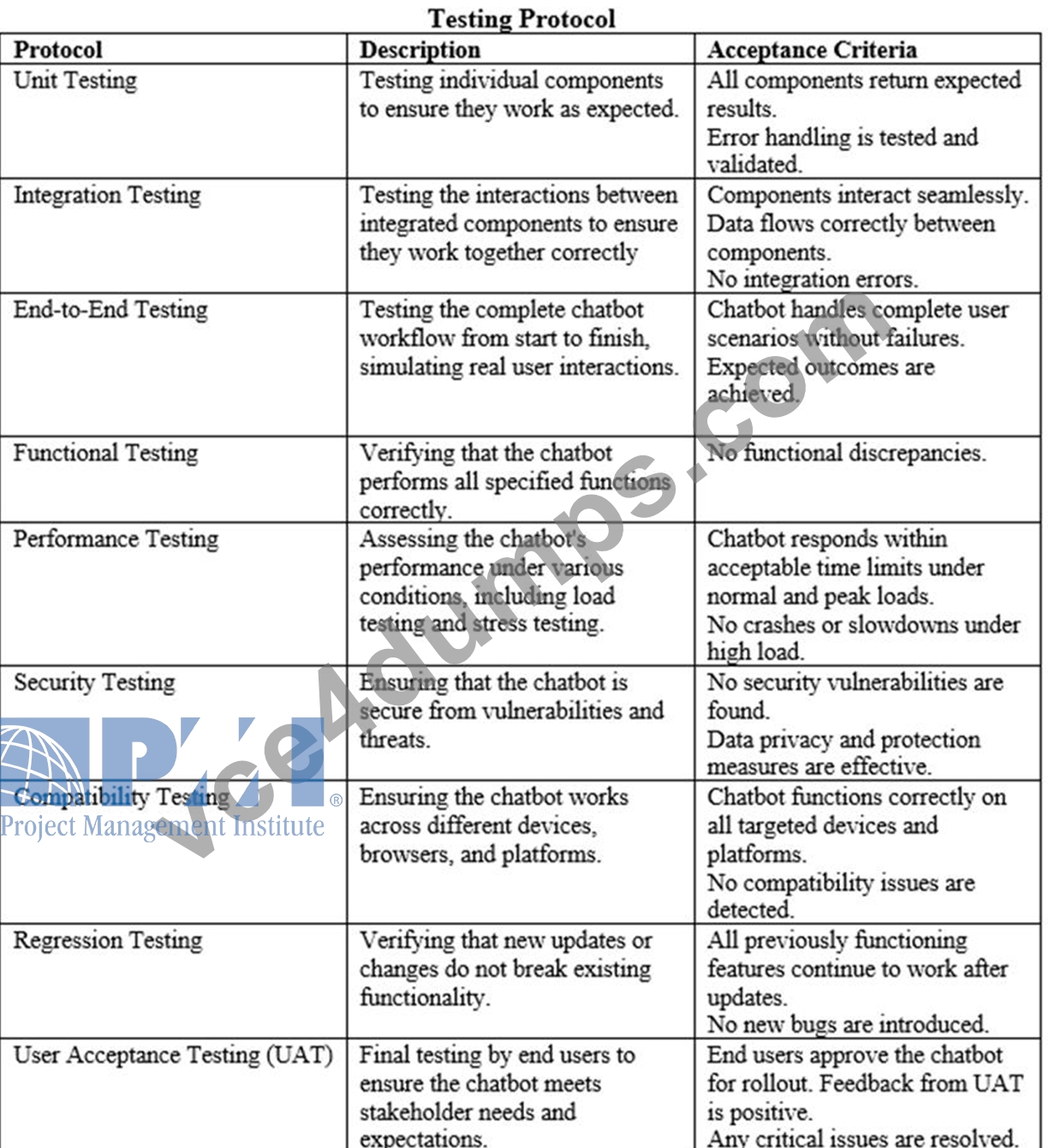
A scrum master is overseeing the launch of a chatbot for the service desk. Complaints come up post-release about edge case responses to queries. After analyzing the issues, the business decision was made to take the chatbot offline, resulting in workflow disruptions and risking the reputation.
How could this situation have been avoided? (Refer to Testing Protocol Table)
- A. Conduct user acceptance testing to ensure the chatbot meets stakeholder needs and expectations.
- B. Conduct regression testing to ensure all previously functioning chatbot features continue to work after updates.
- C. Perform functional testing to verify the chatbot performs the reguired functions.
- D. Perform integration testing to minimize any bugs between the chatbot components.
Answer: A
Explanation:
In the context of the chatbot's post-release complaints about edge cases in query responses, User Acceptance Testing (UAT) is the most critical step to avoid such situations. UAT ensures that the chatbot meets the stakeholder's needs and expectations, which would have included verifying its behavior with real users under real-world scenarios. This step would identify any edge case issues and make sure the chatbot is aligned with business goals before going live.
NEW QUESTION # 61
......
Verified PMI-ACP exam dumps Q&As with Correct 483 Questions and Answers: https://prep4sure.vce4dumps.com/PMI-ACP-latest-dumps.html