


Verified P_SAPEA_2023 dumps Q&As 100% Pass in First Attempt Guaranteed Updated Dump from VCE4Dumps
Pass SAP Certified Professional P_SAPEA_2023 Exam With 49 Questions
NEW QUESTION # 11
As Chief Enterprise Architect, you want to select an extension option that follows SAP's clean-core strategy. What are your recommendations to implement the clean-core strategy best?
- A. Use of public local APIs or public remote APIs for "Developer Extensibility.
- B. Follow SAP's Tier 1 to Tier 2 extension model, which enables different extension options: Cloud Extensibility Model and Cloud API Enablement. This allows the development of cloud- ready and upgrade-stable applications and extensions.
- C. Use "Key User Extensibility" functions of S/4HANA for simple extensions. "Developer Extensibility must comply with the rules for a Tier-1 or Tier-2 extension.
- D. To follow the clean-core strategy, the so-called "Developer Extensibility" of S/4HANA isn't allowed. Extensions must use "Side-by-Side Extensibility" on the SAP Business Technology Platform. These extensions use corresponding public remote APIs of the S/4HANA backend system.
Answer: D
NEW QUESTION # 12
Green Elk & Company is the world's leading manufacturer of agricultural and forestry machinery. The former company slogan "Elk always runs" has recently been changed to "Elk feeds the world". One of Green Elk's strategic goals is to increase its revenue in the emerging markets of China, India, and other parts of Asia by 80 % within three years. This requires a new business model that caters to significantly smaller farms with limited budgets. You are the Chief Enterprise Architect and the CIO asks you to assess the now business model for smaller farms with smaller budgets. By applying the Sustainable Business Model Canvas, which sequence of steps is best practice?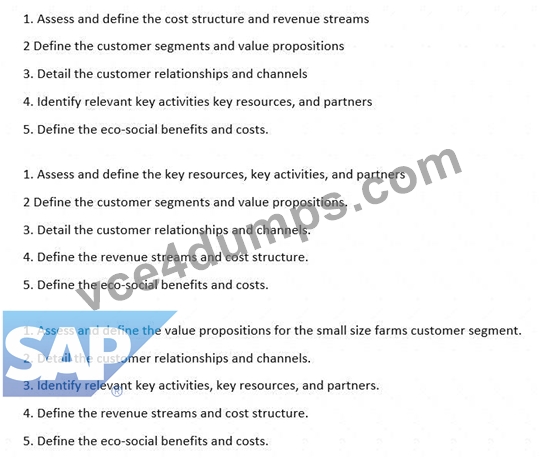
- A. 1. Assess and define the value propositions for the small size farms customer segment.
2. Detail the customer relationships and channels.
3. Identify relevant key activities, key resources, and partners.
4.Define the revenue streams and cost structure.
5. Define the eco-social benefits and costs. - B. 1. Assess and define the cost structure and revenue streams
2 Define the customer segments and value propositions
3. Detail the customer relationships and channels
4. Identify relevant key activities key resources, and partners
5. Define the eco-social benefits and costs. - C. 1. Assess and define the key resources, key activities, and partners
2 Define the customer segments and value propositions.
3. Detail the customer relationships and channels.
4. Define the revenue streams and cost structure.
5. Define the eco-social benefits and costs.
Answer: A
Explanation:
Explanation
According to the Sustainable Business Model Canvas, which is a tool that helps entrepreneurs to design and communicate their business models in a sustainable way, the recommended sequence of steps is:
Assess and define the value propositions for the small size farms customer segment. This step involves defining and describing the products or services that Green Elk & Company offers to its target customers, and how they create value for them. The value propositions should address the needs, problems, or desires of the customers, and highlight the benefits or advantages of Green Elk & Company's solutions over the alternatives.
Detail the customer relationships and channels. This step involves defining and describing how Green Elk & Company interacts with its customers, and how it reaches and delivers its products or services to them. The customer relationships should reflect the type and level of engagement that Green Elk & Company wants to establish and maintain with its customers, such as self-service, personal assistance, or community. The channels should reflect the most effective and efficient ways to communicate and distribute Green Elk & Company's value propositions to its customers, such as online platforms, physical stores, or partners.
Identify relevant key activities, key resources, and partners. This step involves identifying and describing the main activities, resources, and partners that Green Elk & Company needs to perform and leverage to create and deliver its value propositions to its customers. The key activities should reflect the most important tasks or processes that Green Elk & Company undertakes to execute its business model, such as production, marketing, or sales. The key resources should reflect the most essential assets or inputs that Green Elk & Company requires to execute its business model, such as human, physical, financial, or intellectual resources. The key partners should reflect the most strategic relationships or collaborations that Green Elk & Company establishes with other entities to execute its business model, such as suppliers, distributors, or competitors.
Define the revenue streams and cost structure. This step involves defining and describing how Green Elk & Company generates income from its customers, and how much it spends to execute its business model. The revenue streams should reflect the sources and mechanisms of income that Green Elk & Company obtains from selling its products or services to its customers, such as sales, subscriptions, or fees. The cost structure should reflect the types and amounts of expenses that Green Elk & Company incurs to execute its business model, such as fixed costs, variable costs, or economies of scale.
Define the eco-social benefits and costs. This step involves defining and describing how Green Elk & Company contributes to or affects the environment and society through its business model. The eco-social benefits should reflect the positive impacts or externalities that Green Elk & Company creates for the environment and society through its products or services, such as reducing emissions, improving health, or enhancing education. The eco-social costs should reflect the negative impacts or externalities that Green Elk & Company causes for the environment and society through its products or services, such as increasing waste, depleting resources, or harming biodiversity.
The other options (A and B) are not correct for the sequence of steps to apply the Sustainable Business Model Canvas, because they either skip or misrepresent some of the steps in this tool. For example:
Option A is not correct because it does not include assessing and defining the value propositions for the small size farms customer segment, which is a crucial step to understand and communicate how Green Elk & Company creates value for its customers. It also suggests defining the cost structure and revenue streams before defining the customer segments and value propositions, which is not a logical order since the latter determine the former.
Option B is not correct because it does not include identifying relevant key activities, key resources, and partners, which are important aspects of executing a business model. It also suggests retrieving the documentation for the solutions that need to be integrated instead of assessing and defining the value propositions for the small size farms customer segment, which is not relevant for designing a new business model.
For more information on the Sustainable Business Model Canvas and its steps, you can refer to The Sustainable Business Canvas or Sustainable Business Model Canvas: A Review And Framework Development.
NEW QUESTION # 13
Select the most appropriate sequence of critical Business Capabilities for the Business Architecture Roadmap.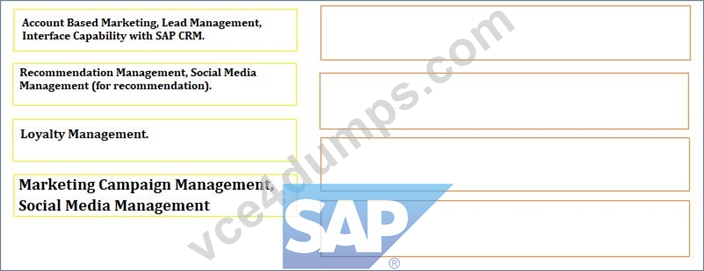
Answer:
Explanation: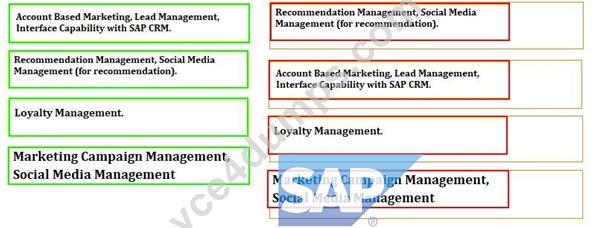
NEW QUESTION # 14
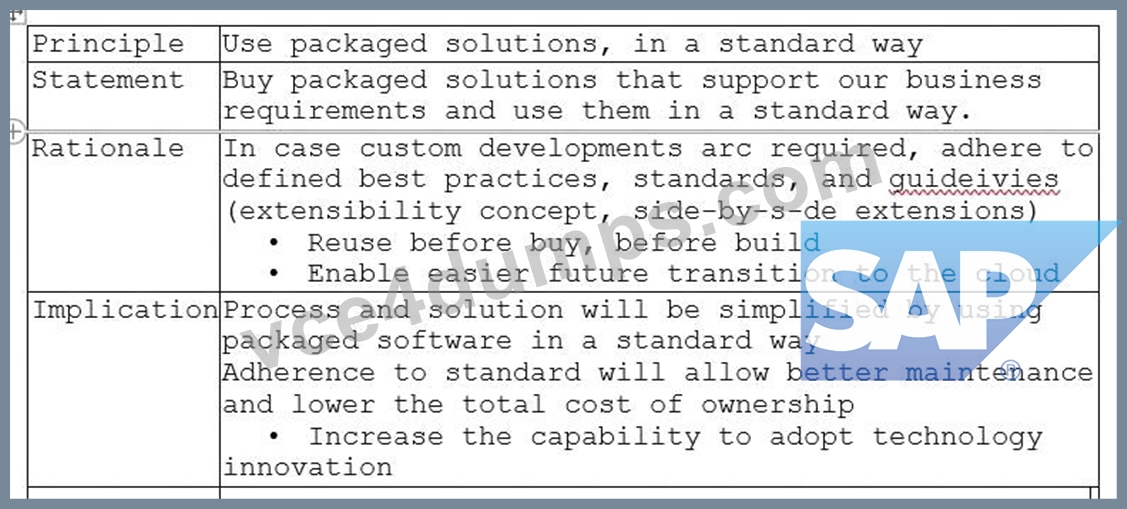
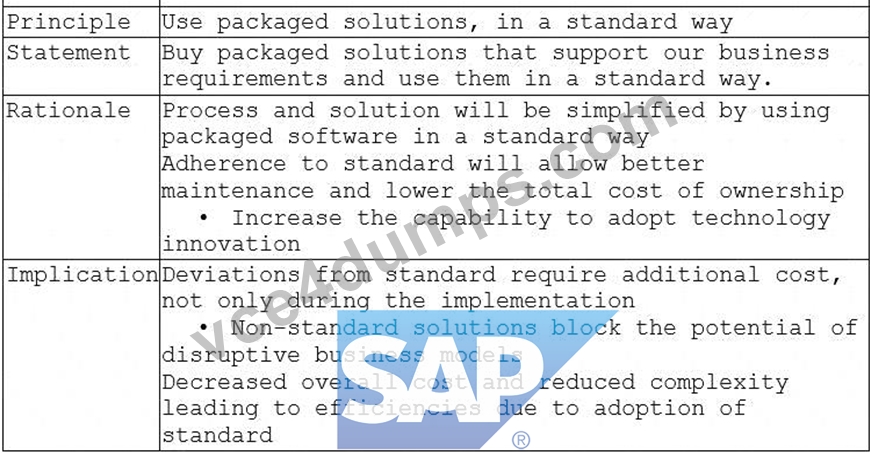
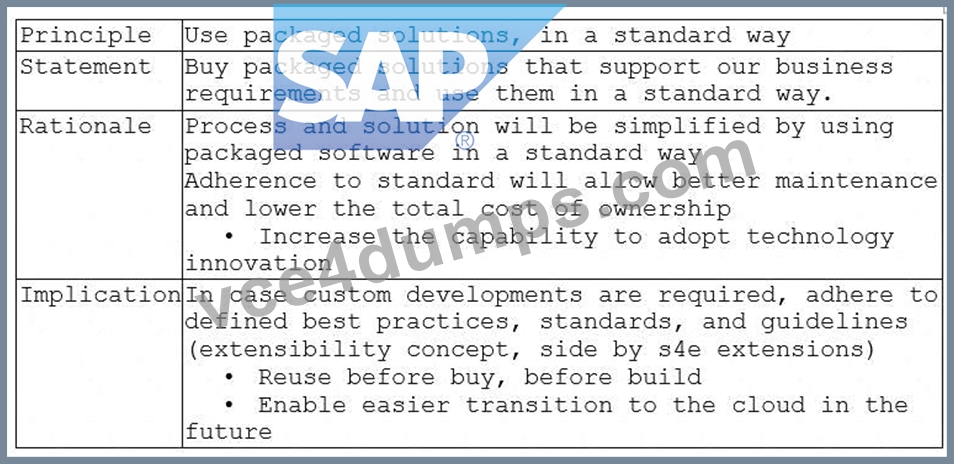
Green Elk & Company is the world s leading manufacturer of agricultural and forestry machinery. The former company slogan "Elk always runs has recently been changed to Elk feeds the world". One of Green Elk's strategic goals is to increase its revenue in the emerging markets of China, India, and other parts of Asia by 80 % within three years. This requires a new business model that caters to significantly smaller farms with limited budgets. You are the Chief Enterprise Architect and the CIO asks you to assess the new business model for smaller farms with smaller budgets. Given the principle and statement, which of the following combinations of rationale and implication do you consider well-defined?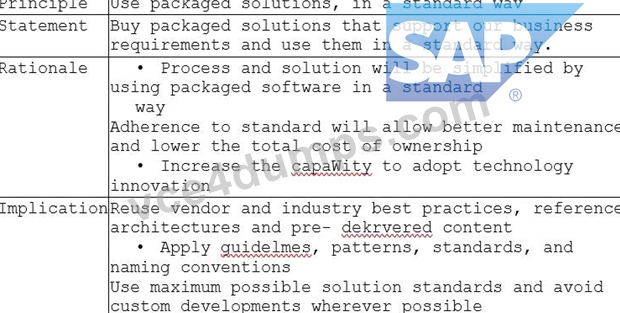
- A. Green Elk & Company is the world's leading manufacturer of agricultural and forestry machinery. The former company slogan "Elk always runs has recently been changed to Elk feeds the world". One of Green Elk's strategic goals is to increase its revenue in the emerging markets of China, India, and other parts of Asia by 80 % within three years. This requires a new business model that caters to significantly smaller farms with limited budgets. You are the Chief Enterprise Architect and the CIO asks you to assess the new business model for smaller farms with smaller budgets. Given the principle and statement, which of the following combinations of rationale and implication do you consider well-defined?
- B. Principle: Use packaged solutions, in a standard way. Statement: Buy packaged solutions that support our business requirements and use them in a standard way. Rationale: Process and solution will be simplified by using packaged software in a standard way/Adherence to standard will allow better maintenance and lower the total cost of ownership/Increase the capability to adopt technology innovation. Implication: In case custom developments are required, adhere to defined best practices, standards, and guidelines (extensibility concept, side by s4e extensions)/Reuse before buy, before build/Enable easier transition to the cloud in the future
- C. Principle: Use packaged solutions, in a standard way. Statement: Buy packaged solutions that support our business requirements and use them in a standard way. Rationale: In case custom developments arc required, adhere to defined best practices, standards, and guide ivies (extensibility concept, side-by-s-de extensions)/Reuse before buy, before build/Enable easier future transition to the cloud. Implication:
Process and solution will be simplified by using packaged software in a standard way/Adherence to standard will allow better maintenance and lower the total cost of ownership/Increase the capability to adopt technology innovation. - D. Principle: Use packaged solutions, in a standard way. Statement: Buy packaged solutions that support our business requirements and use them in a standard way. Rationale: Process and solution will be simplified by using packaged software in a standard way./Adherence to standard will allow better maintenance and lower the total cost of ownership/Increase the capability to adopt technology innovation. Implication: Reuse vendor and industry best practices, reference architectures and pre- decreed content/Apply guideless, patterns, standards, and naming conventions/Use maximum possible solution standards and avoid custom developments wherever possible.
Answer: B
Explanation:
Explanation
The rationale and implication in this combination are well-defined because they both support the principle of using packaged solutions in a standard way. The rationale explains the benefits of using packaged solutions, while the implication outlines the steps that need to be taken to ensure that packaged solutions are used in a standard way.
According to the SAP Enterprise Architecture Framework, which is a methodology and toolset by the German multinational software company SAP that helps enterprise architects define and implement an architecture strategy for their organizations, a principle is a general rule or guideline that expresses a fundamental value or belief, and that guides the design and implementation of the architecture. A principle consists of four elements:
a name, a statement, a rationale, and an implication. The name is a short and memorable label that summarizes the principle. The statement is a concise and precise description of the principle. The rationale is an explanation of why the principle is important and beneficial for the organization. The implication is a description of the consequences or impacts of applying or not applying the principle.
The principle in option D is:
Name: Use packaged solutions, in a standard way.
Statement: Buy packaged solutions that support our business requirements and use them in a standard way.
Rationale: Process and solution will be simplified by using packaged software in a standard way.
Adherence to standard will allow better maintenance and lower the total cost of ownership. Increase the capability to adopt technology innovation.
Implication: In case custom developments are required, adhere to defined best practices, standards, and guidelines (extensibility concept, side-by-side extensions). Reuse before buy, before build. Enable easier transition to the cloud in the future.
This combination of rationale and implication is well-defined because it clearly and logically explains the benefits and consequences of following or not following the principle. The rationale shows how using packaged solutions in a standard way can simplify the process and solution, reduce the cost and effort of maintenance, and increase the ability to adopt new technologies. The implication shows how custom developments should be minimized and standardized, how reuse should be preferred over buying or building new solutions, and how cloud readiness should be considered for future scalability.
The other options (A, B, C) are not correct for the combination of rationale and implication that is well-defined because they either mix up or confuse some of the elements of the principle. For example:
Option A is not correct because it mixes up the rationale and implication elements. The first sentence of the rationale ("Process and solution will be simplified by using packaged software in a standard way") is actually an implication of following the principle, not a reason for following it. The first sentence of the implication ("Reuse vendor and industry best practices, reference architectures and pre-delivered content") is actually a rationale for following the principle, not a consequence of following it.
Option B is not correct because it confuses the rationale and implication elements. The first sentence of the rationale ("In case custom developments are required, adhere to defined best practices, standards, and guidelines (extensibility concept, side-by-side extensions)") is actually an implication of following the principle, not a reason for following it. The first sentence of the implication ("Process and solution will be simplified by using packaged software in a standard way") is actually a rationale for following the principle, not a consequence of following it.
Option C is not correct because it confuses the rationale and implication elements. The second sentence of the rationale ("Adherence to standard will allow better maintenance and lower the total cost of ownership") is actually an implication of following the principle, not a reason for following it. The second sentence of the implication ("Reuse before buy, before build") is actually a rationale for following the principle, not a consequence of following it.
NEW QUESTION # 15
You, as the Chief Enterprise Architect of Wanderlust GmbH, have been trying to formulate the Business Strategy Map. You are currently working on the strategic objective to "Increase supply reliability of Lithium batteries". Arrange the elements of the Business Strategy Map into the right order that shows the dependencies between these elements.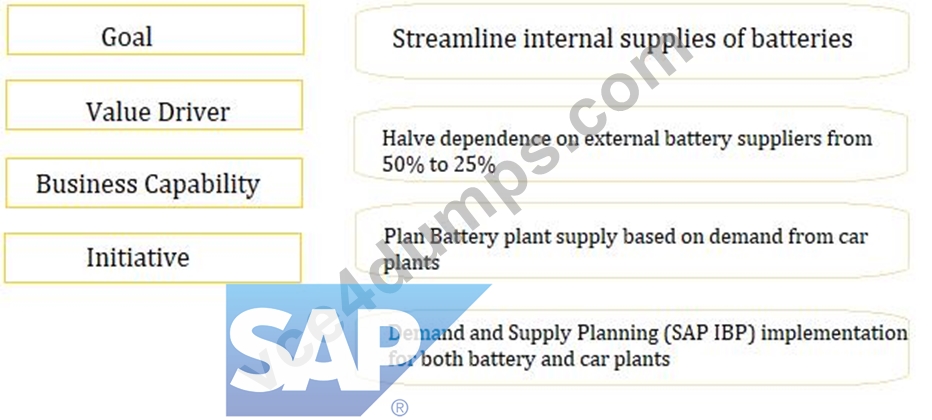
Answer:
Explanation: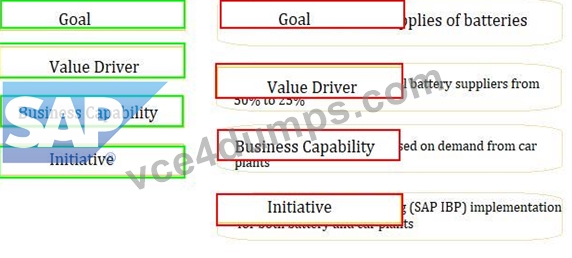
NEW QUESTION # 16
The online marketing channel is targeted only to individual customers, who should be able to choose any of the 50 combinations that Wanderlust offers for its electric cars. Every confirmed online order must be first checked for ready stock availability and, if unavailable, must go for production scheduling. As Chief Enterprise Architect of Wanderlust, along with the SAP Enterprise Architect, you have identified Lead to Cash (L2C) as the key E2E process. However, you have found out that the SAP Reference Business Architecture content has several Business Process Variants of the L2C process, from which you are supposed to choose one suitable variant for Wanderlust's product range and business model. Which of the following combinations of L2C Business Process Variants and business reasons are the most suitable? Note: There are 2 correct answers to this question.
- A. Variant: Lead to Cash-B2C with Make to Stock/Business reason: Each individual customer may order their preferred variant, which may be available in existing stock and met from there.
- B. Variant: Lead to Cash - Business to Business (B2B) with Make to Stock Business reason: Each corporate customer may order in bulk for the same variants repeatedly, which may be available in existing stock and met from there.
- C. Variant: Lead to Cash-B2B with Make to Order/Business reason: Each corporate customer may order different variants, which can be produced only upon receipt of customer order.
- D. Variant: Lead to Cash - Business to Consumer (B2C) with Make to Order Business reason: Each Individual customer may order their preferred variant, which can be produced upon receipt of customer order, if stock is not readily available.
Answer: A,D
Explanation:
Considering Wanderlust's product range and business model, which targets individual customers and offers a wide range of electric car combinations, the Lead to Cash-B2C with Make to Stock variant would be suitable for orders that can be met from existing stock. Similarly, the Lead to Cash-B2C with Make to Order variant would fit the business model when an individual customer orders a combination not available in stock, necessitating production scheduling. Both variants cater to the business-to-consumer (B2C) model and account for the direct sales approach to individual customers.
= These variants would be documented in SAP's Business Process Architecture content, which includes various Lead to Cash process scenarios, adjusted for different business contexts.
NEW QUESTION # 17
Why would you recommend building SAP Side-by-Side Extensions to an S/4HANA system based on SAP BTP?
- A. Extensions on SAP BTP technology can easily use of S/4HANA eventing.
- B. Extensions on SAP BTP can maintain SAP user and security context and allow the use of S/4HANA eventing.
- C. Extensions should be built on SAP BTP because SAP BTP is the only option for building a consistent user experience based on SAP Fiori UX styles.
Answer: B
Explanation:
Explanation
There are a few reasons why you would recommend building SAP Side-by-Side Extensions to an S/4HANA system based on SAP BTP.
SAP BTP is a cloud-based platform, which means that extensions can be developed, deployed, and managed in the cloud. This makes it easy to scale and manage extensions, and it also makes it easier to collaborate with other developers.
SAP BTP provides a number of services that can be used to build extensions, such as SAP Cloud Platform Integration and SAP Cloud Platform Event Mesh. These services can help to make extensions more scalable, reliable, and secure.
SAP BTP supports a variety of programming languages, which means that developers can use the language they are most comfortable with. This can help to make the development process more efficient and productive.
In addition to these reasons, SAP BTP also allows extensions to maintain SAP user and security context and allow the use of S/4HANA eventing. This is important because it ensures that users are only able to access the data and functionality that they are authorized to access, and it also allows extensions to react to events that occur in S/4HANA.
Therefore, SAP BTP is a good choice for building SAP Side-by-Side Extensions to an S/4HANA system.
Extensions on SAP BTP can maintain SAP user and security context, which means that the extensions can use the same authentication and authorization mechanisms as the S/4HANA system and respect the user roles and permissions defined in the S/4HANA system.
Extensions on SAP BTP can use S/4HANA eventing, which means that the extensions can subscribe to business events that are triggered by the S/4HANA system and react to them accordingly. For example, an extension can listen to a sales order creation event and perform some additional logic or integration based on the event data.
Extensions on SAP BTP can leverage the SAP Cloud Platform Integration Suite and the SAP HANA Data Management Suite, which provide a comprehensive set of services and tools for different integration scenarios, such as process integration, data integration, analytics integration, user integration, and thing integration.
Extensions on SAP BTP can benefit from the cloud-native capabilities of SAP BTP, such as scalability, elasticity, availability, and security. Extensions on SAP BTP can also take advantage of the various programming languages, frameworks, and technologies supported by SAP BTP, such as Java, Node.js, Python, Go, PHP, CAP, or serverless functions.
Verified References: 6:
https://help.sap.com/viewer/9d1db9835307451daa8c930fbd9ab264/2020.002/en-US/6f7b0c5a5e0d4f8a8b7c0e9c
NEW QUESTION # 18
While discussing the Smart Battery initiative in greater detail with the appropriate stakeholder, as Chief Enterprise Architect of Wanderlust, you discover that several key areas such as value proposition, cost structure, revenue streams, partners, and channels have been worked upon in isolation and therefore do not tally with each other. Which artifact would you recommend to bring all the above key dimensions together in a single window, to have a unified, consistent, holistic view of the Smart Battery initiative?
- A. Statement of Architecture Work
- B. Business Model Canvas
- C. Architecture Principles
- D. Business Strategy Map
Answer: B
Explanation:
Explanation
A Business Model Canvas is a strategic management and entrepreneurial tool that allows you to describe, design, challenge, invent, and pivot your business model1. A Business Model Canvas consists of nine building blocks that cover the four main areas of a business: customers, offer, infrastructure, and financial viability2.
These building blocks are:
Value Proposition: The value that you deliver to your customers and the problem that you solve for them.
Customer Segments: The different groups of people or organizations that you aim to reach and serve.
Channels: The ways that you communicate with and deliver value to your customers.
Customer Relationships: The types of relationships that you establish and maintain with your customers.
Revenue Streams: The sources of income that you generate from your value proposition.
Key Resources: The most important assets that you need to create and deliver your value proposition.
Key Activities: The most important things that you do to create and deliver your value proposition.
Key Partnerships: The network of suppliers and partners that help you create and deliver your value proposition.
Cost Structure: The most significant costs that you incur to create and deliver your value proposition.
A Business Model Canvas is a useful artifact to bring all the key dimensions of the Smart Battery initiative together in a single window, to have a unified, consistent, holistic view of the initiative. By using a Business Model Canvas, you can:
Visualize the entire business model of the Smart Battery initiative on one page.
Identify the gaps, inconsistencies, or conflicts among the different elements of the business model.
Align the value proposition, cost structure, revenue streams, partners, and channels with the customer segments and their needs.
Test and validate your assumptions and hypotheses about the business model.
Iterate and improve your business model based on feedback and data.
Verified References: 1: https://www.strategyzer.com/canvas/business-model-canvas | 2:
https://www.investopedia.com/terms/b/business-model-canvas.asp
NEW QUESTION # 19
Which artifacts does SAP provide as part of the SAP Reference Business Architecture content?
- A. Business Capability Model/Business Data Model/Business Role Model/Product Map
- B. Business Capability Model/Business Process Model
- C. Business Process Model/Solution Process Model
Answer: A
Explanation:
SAP provides a comprehensive set of artifacts as part of its SAP Reference Business Architecture content to support enterprises in designing their business architecture efficiently and effectively. The correct answer, A, encompasses a broad range of these artifacts:
Business Capability Model: Defines the capabilities an organization requires to achieve its business objectives and outcomes.
Business Data Model: Outlines the structure of the data elements within an organization and their relationships.
Business Role Model: Describes roles within the organization and their responsibilities.
Product Map: Provides an overview of the products and services an organization offers and how they relate to business capabilities and processes.
These artifacts are foundational for understanding and designing the enterprise's business architecture, ensuring alignment with strategic goals, technological capabilities, and operational processes.
Reference:
SAP Reference Architecture documentation.
SAP Business Architecture Services.
NEW QUESTION # 20
What kind of applications can you develop with SAP Business Application Studio?
- A. ABAP applications
- B. SAPUI5 (SAP Fiori) applications
- C. SAPUI5 (SAP Fiori) applications and ABAP applications
Answer: B
Explanation:
SAP Business Application Studio is a modern development environment designed to support the development of various SAP-centric applications. Among the supported application types are:
SAPUI5 (SAP Fiori) applications (C): SAP Business Application Studio provides extensive tools and templates specifically tailored for developing SAPUI5 applications, which are the backbone of the SAP Fiori user experience. This includes support for frontend development with rich user interfaces, integration with SAP services, and adherence to SAP Fiori design principles.
Options A and B are incorrect because SAP Business Application Studio does not support ABAP development directly within its environment. ABAP development traditionally requires a different set of tools and environments provided by SAP, such as the ABAP Development Tools (ADT) in Eclipse or the ABAP environment on SAP Cloud Platform.
:
SAP Business Application Studio documentation.
SAP Fiori development guidelines provided by SAP.
NEW QUESTION # 21
Which of the following roles are missing from Wanderlust's current Enterprise Architecture practice structure? Note: There are 2 correct answers to this question.
- A. Data Architect
- B. Business Architect
- C. Application Architect
- D. Architecture Board
Answer: B,C
Explanation:
From the current Enterprise Architecture practice structure presented for Wanderlust GmbH, it appears that there are dedicated roles for a Chief Enterprise Architect and a Technology Architect. However, the roles of Application Architect and Business Architect are not explicitly mentioned. An Application Architect is crucial for designing and maintaining the application landscape, ensuring that it aligns with business requirements, while a Business Architect is essential for aligning IT strategy with business strategy and understanding the impact of business changes on the architecture. Their absence indicates a gap in ensuring the alignment between business processes and IT systems, as well as in defining and maintaining the application strategy.
Reference = The roles and responsibilities within an Enterprise Architecture framework typically include both Application and Business Architects to ensure a comprehensive approach to aligning IT and business strategies.
NEW QUESTION # 22
As an Enterprise Architect, you must ensure that future extensions to the Digital Core of the enterprise guarantee stable and reliable operations. The architecture guideline demands to follow the clean-core strategy. What does this demand ensure and entail?
- A. Extensions may access SAP tables directly and in a well-documented, clean way. Therefore, the code of extensions can be adapted quickly to accommodate future changes.
- B. Extensions do not break an upgrade, and upgrades do not break an extension. Such extensions can access SAP business objects only through well defined, upgrade-stable interfaces.
- C. Extensions are kept strictly separate from the SAP application, Extensions are developed in accordance with the SAP Application Extension Methodology. Side-by-side extensibility options are always preferable to on-stack extensibility options.
Answer: B
Explanation:
The clean-core strategy is fundamental to ensuring that the Digital Core remains stable and reliable during operations and future upgrades. By following this strategy, any extensions made are guaranteed not to affect the core system upgrades, and likewise, system upgrades will not disrupt the functionality of the extensions. This is achieved by using well-defined and stable interfaces for extensions to interact with SAP business objects, ensuring compatibility and stability across system updates.
= The SAP architecture guidelines which prescribe maintaining a clean core, detailing how to develop extensions that are compatible with SAP's upgrade strategy and protect the integrity of the core system.
NEW QUESTION # 23
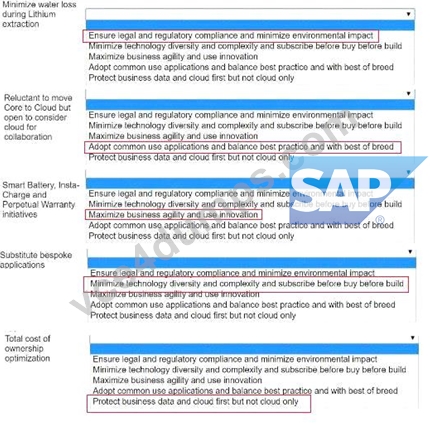
As the Chief Enterprise Architect of Wanderlust GmbH, you are aware that EA principles should correlate to the Business and IT Strategic Objectives and decisions. In the list given below, the left column has some Wanderlust Business/IT objectives and decisions and the right column has some EA principles. Which objectives and decisions correlate best to which principle?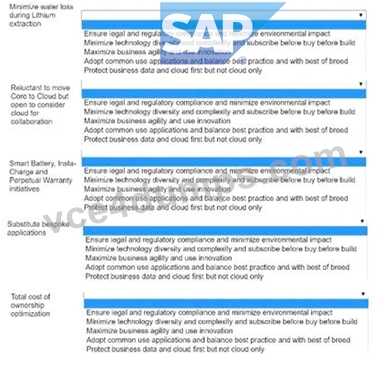
Answer:
Explanation: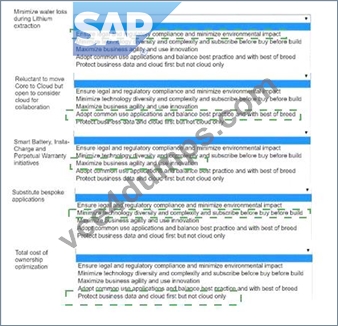
NEW QUESTION # 24
As the Chief Enterprise Architect of Wanderlust GmbH, you know that there is very little process documentation available on online marketing processes within Wanderlust. You also know that SAP has a rich End-to-End (E2E) Business Processes content repository. To take advantage of that, you have engaged an SAP Enterprise Architect. The SAP Enterprise Architect is using SAP's Business Process Model (BPM) and the Business Capability Model (BCM) while mapping processes to capabilities, how are the two models connected? Note: There are 2 correct answers to this question.
- A. Through the Enterprise Domain, to which both the E2E Business Process of BPM and the Business Domain of BCM are assigned.
- B. Through the Business Activity of BPM, which is enabled by the Business Capability of BCM.
- C. Through the E2E Business Process of BPM, which is enabled by the Business Domain of BCM.
- D. Through the Business Process Module of BPM, which is directly linked to the Business Area of BCM.
Answer: B,C
NEW QUESTION # 25
You, as the Chief Enterprise Architect of Wanderlust GmbH, have been trying to formulate the Business Strategy Map. You are currently working on the strategic objective to "Increase supply reliability of Lithium batteries". Arrange the elements of the Business Strategy Map into the right order that shows the dependencies between these elements.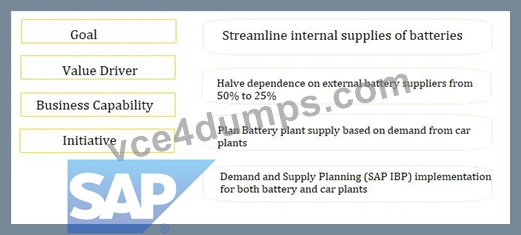
Answer:
Explanation: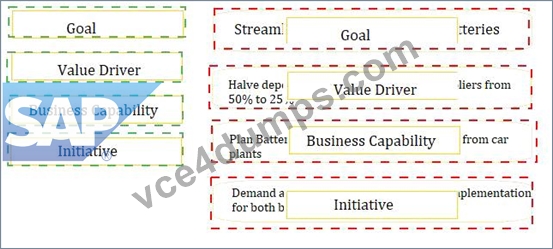
Explanation
Goal - Increase supply reliability of Lithium batteries
Value Driver - Halve dependence on external battery suppliers from 50% to 25% Business Capability - Plan Battery plant supply based on demand from car plants Initiative- Demand and Supply Planning (SAP IBP) implementation for both battery and car plants Verified References: 1:
https://www.indeed.com/career-advice/career-development/how-to-create-strategy-map | 2:
https://creately.com/guides/what-is-a-strategy-map/ | 3:
https://www.lucidchart.com/blog/strategy-mapping-example
NEW QUESTION # 26
Select the most appropriate sequence of critical Business Capabilities for the Business Architecture Roadmap.
Answer:
Explanation: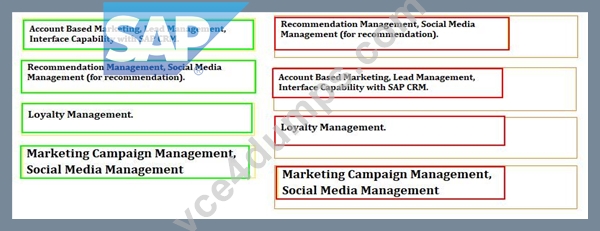
NEW QUESTION # 27
For the next Architecture Board meeting, you need to determine the next steps required after the business, application/data and technology architecture designs have been created. What do you recommend?
- A. Reviewing Business Application/Data and Technology Architecture artifacts with stakeholders and signing off on first versions.Using Transition Architectures to build the Architecture Roadmap. Creating first drafts of the required work packages and the Project/Rollout plan.
- B. Establishing change management processes for the management of the business application/data and technology artifacts Handing over the artifacts to the implementation partner and rolling out the project
- C. Finalizing the Business, Application/Data, and Technology Architecture artifacts. Building an Architecture Roadmap. Creating a first draft of the Project/Rollout Project plan.
Answer: A
Explanation:
After the business, application/data, and technology architecture designs have been created, it is vital to engage with stakeholders to review these artifacts and gain their sign-off, ensuring that the designs meet the business requirements and are aligned with the strategic direction of the company. Transition Architectures are an essential part of building the Architecture Roadmap as they provide interim 'target states' that enable the organization to move towards the final architecture in a controlled manner. Creating the initial drafts of the work packages and the project/rollout plan is necessary to commence the detailed planning for implementation.
= This approach is documented within the SAP Enterprise Architecture development process, which underscores the importance of stakeholder engagement, Transition Architectures, and detailed planning for successful EA implementation. Relevant documents include "SAP Enterprise Architecture Framework" and "Transition Architecture Planning in SAP Environments."
NEW QUESTION # 28
Why would you recommend building SAP Side-by-Side Extensions to an S/4HANA system based on SAP BTP?
- A. Extensions on SAP BTP technology can easily use of S/4HANA eventing.
- B. Extensions on SAP BTP can maintain SAP user and security context and allow the use of S/4HANA eventing.
- C. Extensions should be built on SAP BTP because SAP BTP is the only option for building a consistent user experience based on SAP Fiori UX styles.
Answer: B
Explanation:
There are a few reasons why you would recommend building SAP Side-by-Side Extensions to an S/4HANA system based on SAP BTP.
SAP BTP is a cloud-based platform, which means that extensions can be developed, deployed, and managed in the cloud. This makes it easy to scale and manage extensions, and it also makes it easier to collaborate with other developers.
SAP BTP provides a number of services that can be used to build extensions, such as SAP Cloud Platform Integration and SAP Cloud Platform Event Mesh. These services can help to make extensions more scalable, reliable, and secure.
SAP BTP supports a variety of programming languages, which means that developers can use the language they are most comfortable with. This can help to make the development process more efficient and productive.
In addition to these reasons, SAP BTP also allows extensions to maintain SAP user and security context and allow the use of S/4HANA eventing. This is important because it ensures that users are only able to access the data and functionality that they are authorized to access, and it also allows extensions to react to events that occur in S/4HANA.
Therefore, SAP BTP is a good choice for building SAP Side-by-Side Extensions to an S/4HANA system.
Extensions on SAP BTP can maintain SAP user and security context, which means that the extensions can use the same authentication and authorization mechanisms as the S/4HANA system and respect the user roles and permissions defined in the S/4HANA system.
Extensions on SAP BTP can use S/4HANA eventing, which means that the extensions can subscribe to business events that are triggered by the S/4HANA system and react to them accordingly. For example, an extension can listen to a sales order creation event and perform some additional logic or integration based on the event data.
Extensions on SAP BTP can leverage the SAP Cloud Platform Integration Suite and the SAP HANA Data Management Suite, which provide a comprehensive set of services and tools for different integration scenarios, such as process integration, data integration, analytics integration, user integration, and thing integration.
Extensions on SAP BTP can benefit from the cloud-native capabilities of SAP BTP, such as scalability, elasticity, availability, and security. Extensions on SAP BTP can also take advantage of the various programming languages, frameworks, and technologies supported by SAP BTP, such as Java, Node.js, Python, Go, PHP, CAP, or serverless functions.
Verified Reference: 6: https://help.sap.com/viewer/9d1db9835307451daa8c930fbd9ab264/2020.002/en-US/6f7b0c5a5e0d4f8a8b7c0e9c6b6a7f5e.html#loio6f7b0c5a5e0d4f8a8b7c0e9c6b6a7f5e__section_2
NEW QUESTION # 29
Which of the following roles are missing from Wanderlust's current Enterprise Architecture practice structure? Note: There are 2 correct answers to this question.
- A. Data Architect
- B. Business Architect
- C. Application Architect
- D. Architecture Board
Answer: B,C
Explanation:
From the current Enterprise Architecture practice structure presented for Wanderlust GmbH, it appears that there are dedicated roles for a Chief Enterprise Architect and a Technology Architect. However, the roles of Application Architect and Business Architect are not explicitly mentioned. An Application Architect is crucial for designing and maintaining the application landscape, ensuring that it aligns with business requirements, while a Business Architect is essential for aligning IT strategy with business strategy and understanding the impact of business changes on the architecture. Their absence indicates a gap in ensuring the alignment between business processes and IT systems, as well as in defining and maintaining the application strategy.
= The roles and responsibilities within an Enterprise Architecture framework typically include both Application and Business Architects to ensure a comprehensive approach to aligning IT and business strategies.
NEW QUESTION # 30
Green Elk & Company is the world's leading manufacturer of agricultural and forestry machinery. The former company slogan "Elk always runs" has recently been changed to "Elk feeds the world" One of Green Elk's strategic goals is to increase its revenue in the emerging markets of China, India and other parts of Asia by 80 % within three years. This requires a new business model that caters to significantly smaller farms with limited budgets The CIO asks you, the Chief Enterprise Architect, to present an architecture vision to address the aforementioned business challenge. According to the SAP Enterprise Architecture Framework, what is the best approach?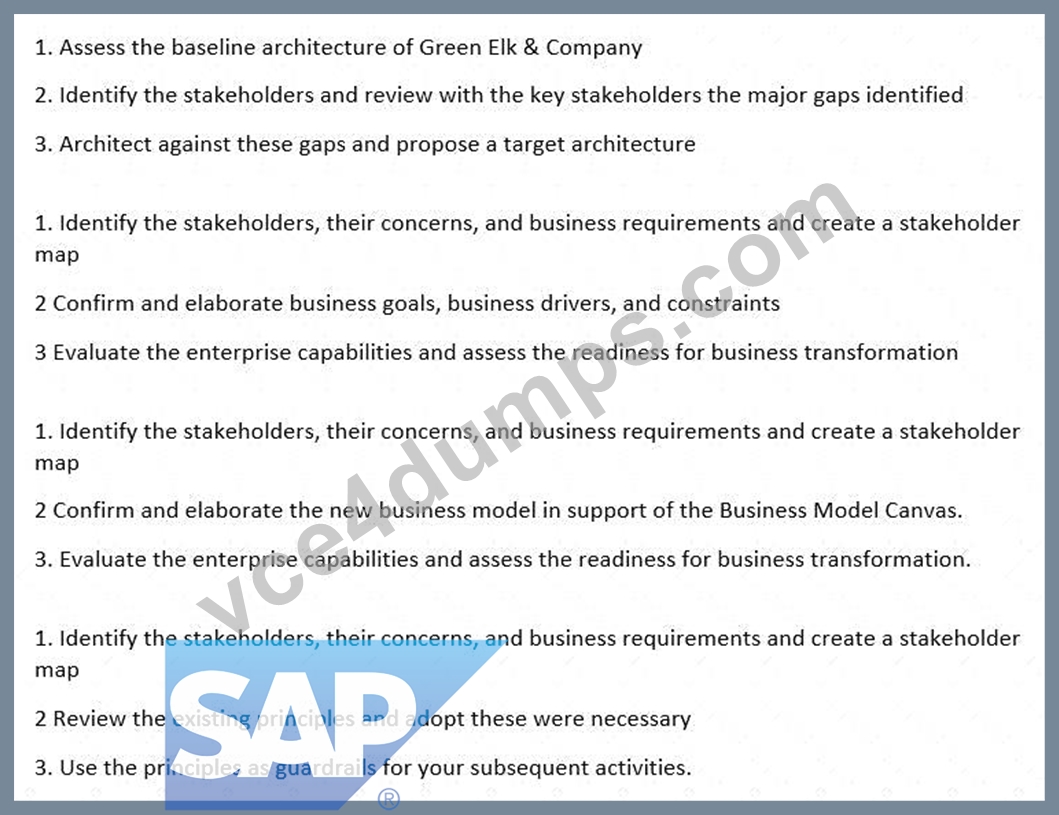
- A. 1. Identify the stakeholders, their concerns, and business requirements and create a stakeholder map.2 Review the existing principles and adopt these were necessary3. Use the principles as guardrails for your subsequent activities.
- B. 1. Identify the stakeholders, their concerns, and business requirements and create a stakeholder map/2 Confirm and elaborate the new business model in support of the Business Model Canvas./3. Evaluate the enterprise capabilities and assess the readiness for business transformation.
- C. 1. Identify the stakeholders, their concerns, and business requirements and create a stakeholder map/2 Confirm and elaborate business goals, business drivers, and constraints/3 Evaluate the enterprise capabilities and assess the readiness for business transformation
- D. 1. Assess the baseline architecture of Green Elk & Company/2. Identify the stakeholders and review with the key stakeholders the major gaps identified/3. Architect against these gaps and propose a target architecture.
Answer: B
Explanation:
Explanation
According to the SAP Enterprise Architecture Framework, which is based on the TOGAF ADM, the architecture vision is the first phase of the architecture development cycle. The purpose of this phase is to define the scope, objectives, and stakeholders of the architecture project, and to create a high-level vision of the desired outcome. The steps involved in this phase are:
Identify the stakeholders, their concerns, and business requirements and create a stakeholder map. This step involves identifying and analyzing the key stakeholders of the architecture project, such as business owners, users, customers, partners, vendors, regulators, etc. The stakeholder map is a document that shows the relationships and interests of the stakeholders, as well as their expectations and concerns regarding the architecture project.
Confirm and elaborate the new business model in support of the Business Model Canvas. This step involves confirming and refining the business goals, drivers, and constraints that motivate the architecture project, and defining the new business model that will enable the achievement of those goals. The Business Model Canvas is a tool that helps to describe, design, and analyze the new business model in a structured and visual way. It consists of nine building blocks that cover the key aspects of the business model, such as value proposition, customer segments, revenue streams, cost structure, etc.
Evaluate the enterprise capabilities and assess the readiness for business transformation. This step involves evaluating the current state of the enterprise in terms of its capabilities, resources, processes, systems, and culture, and assessing how ready it is for undergoing a business transformation. This step also involves identifying the gaps and risks that need to be addressed or mitigated in order to achieve the desired future state.
The other options (A, B, D) are not correct for the architecture vision according to the SAP Enterprise Architecture Framework, because they either skip or misrepresent some of the steps in this phase. For example:
Option A is not correct because it does not include creating a stakeholder map or confirming and elaborating the new business model in support of the Business Model Canvas, which are essential steps to define and communicate the scope and objectives of the architecture project.
Option B is not correct because it does not include creating a stakeholder map or defining a new business model in support of the Business Model Canvas, which are essential steps to understand and align with the needs and expectations of the stakeholders.
Option D is not correct because it does not include confirming and elaborating the new business model in support of the Business Model Canvas or evaluating the enterprise capabilities and assessing the readiness for business transformation, which are essential steps to define and validate the desired outcome and identify the gaps and risks.
For more information on the SAP Enterprise Architecture Framework and its phases, you can refer to SAP Enterprise Architecture | SAP Help Portal or SAP Certified Professional - SAP Enterprise Architect.
NEW QUESTION # 31
......
Pass P_SAPEA_2023 Tests Engine pdf - All Free Dumps: https://prep4sure.vce4dumps.com/P_SAPEA_2023-latest-dumps.html