


Pegasystems PEGACPDC25V1 Certification All-in-One Exam Guide Jun-2026
Get Real PEGACPDC25V1 Exam Dumps [Jun-2026] Practice Tests
NEW QUESTION # 40
A bank has been running traditional marketing campaigns for many years. One such campaign sends an offer email to qualified customers on day one. On day five, the bank presents a similar offer if the first email is ignored.
If you re-implement this requirement by using the always-on outbound customer engagement paradigm, how do you approach this scenario?
- A. Create two segments to identify the target audience for each of the two offer emails: day one, and day five. Set up two schedules per day for the two segments.
- B. Configure the primary schedule to run daily and let the artificial intelligence (AI) choose the best action based on engagement policies.
- C. Configure a primary schedule for the original offer email and setup an ad-hoc schedule to send the second email.
- D. Create an action with a flow that contains two Send Email shapes, one for each email. Set appropriate wait times between the shapes.
Answer: B
Explanation:
The always-on outbound customer engagement paradigm relies on AI to select the best action for each customer at any given time, based on their profile, context, and behavior. You do not need to create separate segments or schedules for different offers or timings. You can configure the primary schedule to run daily and let the AI choose the best action based on engagement policies, such as contact policies, eligibility rules, suitability rules, and arbitration. The AI will also learn from the customer responses and optimize the action selection over time.
NEW QUESTION # 41
U+ Bank, a retail bank, uses the business operations environment to perform its business changes. The bank carries out these changes in the Pega Customer Decision Hub portal by using revision management features or the 1:1 Operations Manager portal.
For each task, select the correct portal in which you perform the build tasks based on best practices.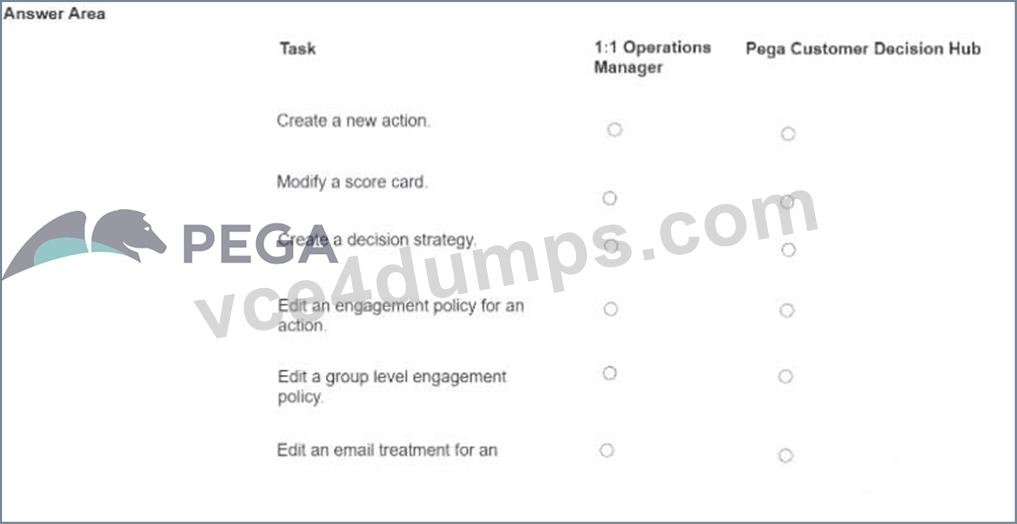
Answer:
Explanation: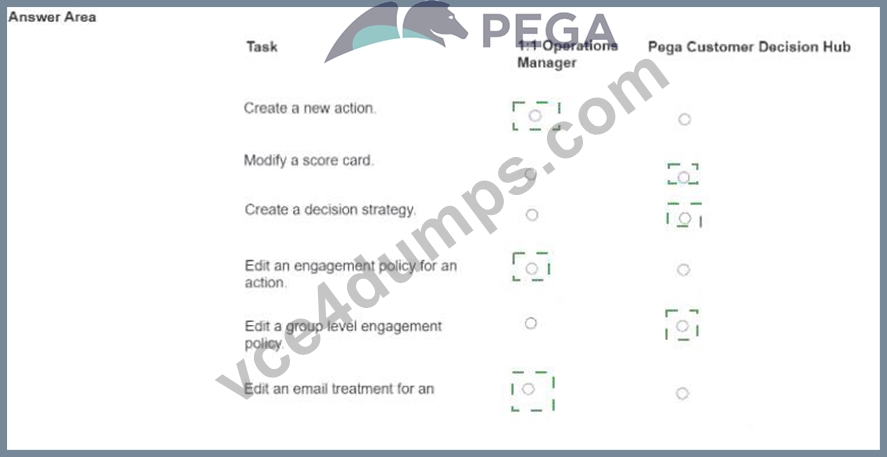
Explanation: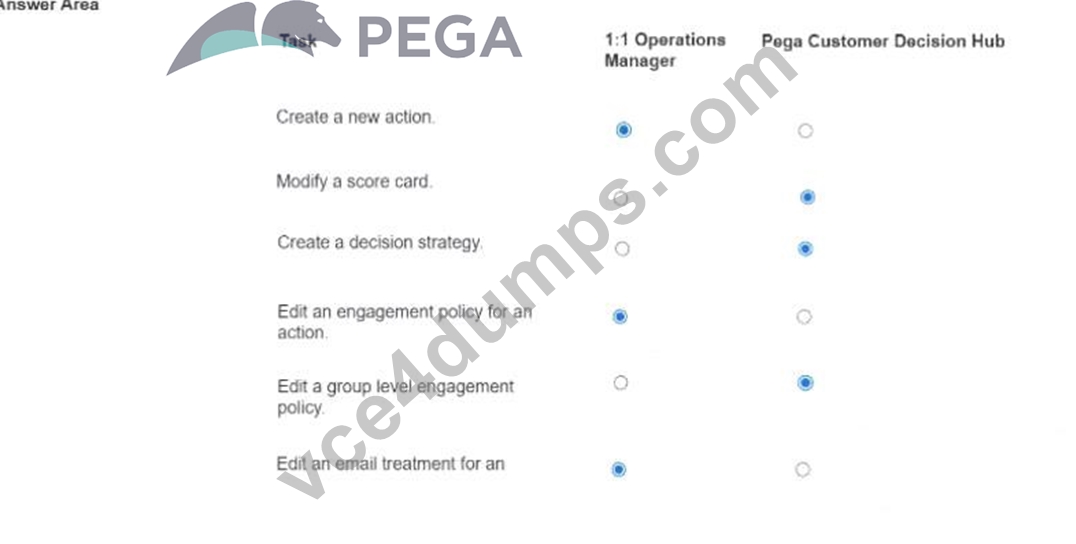
NEW QUESTION # 42
MyCo, a telecom company, recently introduced a new mobile handset offer, MyFone 14 Pro, for its premium customers. As the bank has financial targets to meet, the business decides to boost the MyFone 14 Pro offer.
As a decisioning architect, how can you ensure that the MyFone 14 Pro offer is prioritized over other offers?
- A. Increase the business weight of the MyFone 14 Pro offer.
- B. Increase the business value of the MyFone 14 Pro offer.
- C. Increase the context weight of the MyFone 14 Pro offer.
- D. Increase the starting propensity of the MyFone 14 Pro offer.
Answer: A
Explanation:
The business weight is a parameter that allows you to manually adjust the priority of an offer based on your business objectives and preferences. The business weight is multiplied by the business value and the propensity to calculate the final priority score of an offer. A higher business weight means a higher priority score, making the offer more likely to be selected and presented to the customer. Therefore, if you want to boost an offer, you can increase its business weight. Verified References: Pega Decisioning Consultant | Pega Academy
NEW QUESTION # 43
MyCo, a telecom company, developed a new data plan group to suit the needs of its customers. The following table lists the three data plan actions and the criteria that customers must satisfy to qualify for the offer: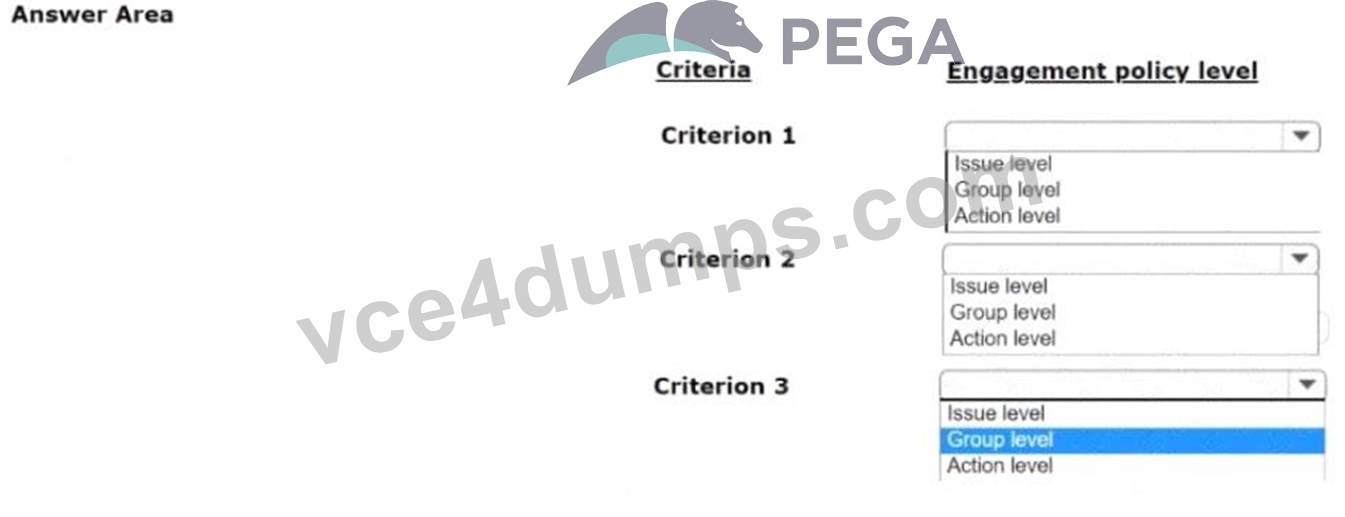
Answer:
Explanation: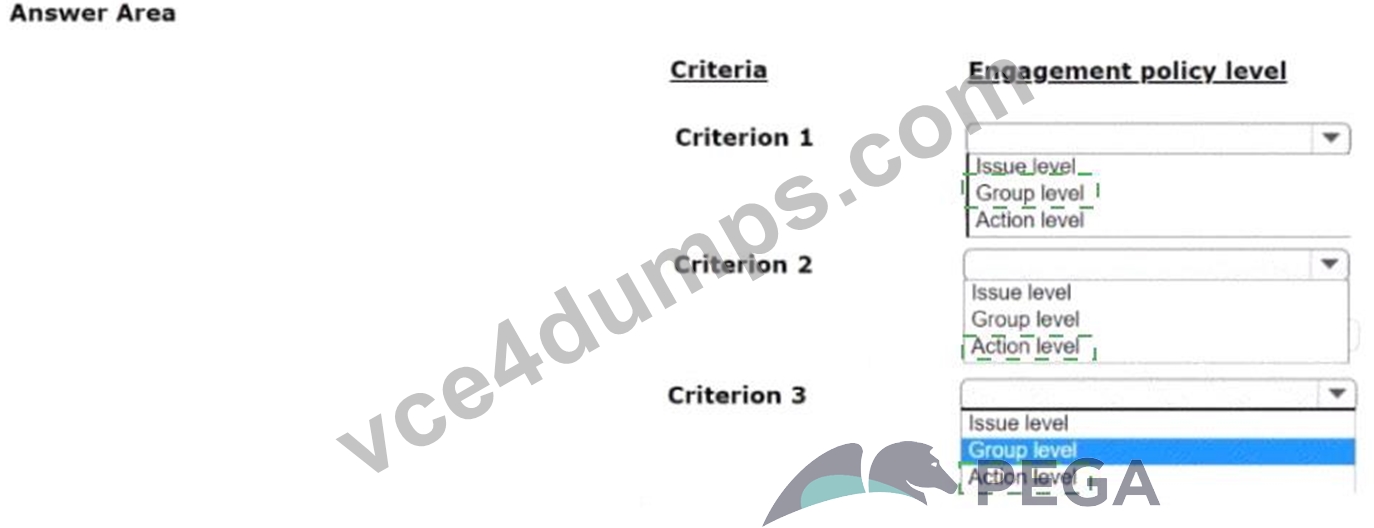
Explanation:
A screenshot of a computer screen AI-generated content may be incorrect.
NEW QUESTION # 44
l)+ Bank uses Pega Customer Decision Hub to approve credit card limit changes requested by customers automatically. A scorecard model determines the customer credit score. The automatic approval of credit card limits are processed based on the following criteria set by the bank.
The bank wants to change the threshold value for the USD2000 credit limit from <175 to <200. How do you implement this change?
- A. Change in the strategy the condition from .pxSegment <=175 to .pxSegment <=200.
- B. Change the cutoff value in the Results tab of the scorecard decision component.
- C. Map the score value in the decision strategy to <=200.
- D. Change the cutoff value in the Results tab of the scorecard model.
Answer: D
Explanation:
The scorecard model determines the customer credit score based on various factors, such as income, expenses, assets, liabilities, etc. The scorecard model has a Results tab where you can define the cutoff values for different segments based on the credit score. To change the threshold value for the USD2000 credit limit from <175 to <200, you need to change the cutoff value in the Results tab of the scorecard model. Changing the cutoff value in the scorecard decision component, changing the condition in the strategy, or mapping the score value in the decision strategy will not affect the credit score calculation or segmentation.
NEW QUESTION # 45
MyCo, a telecom company, notices that when customers call to check on bill status, 80% of the time, they received the wrong offer promotion, leading to customer dissatisfaction. The company decides to boost customers' needs in the prioritization formula, to Improve sales in the current quarter.
Which arbitration factor do you configure to implement the requirement?
- A. Context weighting
- B. Business value
- C. Propensity
- D. Business weighting
Answer: A
NEW QUESTION # 46
In a decision strategy, to use a customer property in an expression, you
- A. use the property as defined without any prefix
- B. define Customer page in Pages & Classes
- C. prefix the property with the keyword Customer
- D. define the property as a strategy property
Answer: B
Explanation:
In a decision strategy, to use a customer property in an expression, you need to define Customer page in Pages
& Classes and specify its class as Data-Customer. This allows you to access customer properties by using dot notation, such as Customer.Age or Customer.Gender. You do not need to define the property as a strategy property, use it without any prefix, or prefix it with the keyword Customer. Verified References: [Certified Pega Decisioning Consultant | Pega Academy], Decision strategies
NEW QUESTION # 47
MyCo, a telecom company, wants to Include offer-related images in the emails that they send to their qualified customers. As a decisioning architect, what best practice do you follow to include images in emails?
- A. Attach images to the email.
- B. Host images on an external server.
- C. Directly embed images in the email.
- D. Provide links to images In the email.
Answer: B
NEW QUESTION # 48
U+ Bank wants to offer credit cards only to customers with a low-risk profile. The customers are divided into various risk segments from AAA to CCC. The risk segmentation rules that the business provides use the Age and the customer Credit Score based on the following table. The bank uses a scorecard model to determine the customer Credit Score.
As a decisioning architect, how do you implement the business requirement?
- A. Add the risk segmentation rules in the Results tab of the scorecard rule.
- B. Add a decision table to a decision strategy and reference it in the scorecard component.
- C. Add a decision table to a decision strategy and pass the credit score as the parameter.
- D. Add three contact policies that correspond to the three risk segments.
Answer: C
Explanation:
To implement the business requirement, you need to add a decision table to a decision strategy and pass the credit score as the parameter. A decision table allows you to define rules based on one or more input parameters and return an output value. In this case, you can use the credit score as an input parameter and return the risk category/grade as an output value. You can then use this output value to filter out customers who are not in the low-risk segment (AAA). Verified Reference: Pega Academy - Decisioning Consultant - Using decision tables
NEW QUESTION # 49
U+ Bank, a retail bank, has recently implemented a project in which credit card offers are presented to qualified customers when they log in to the web self-service portal. The bank added engagement policy conditions to show the offers based on the bank's requirements.
In the Answer Area, select the correct engagement policy for each condition.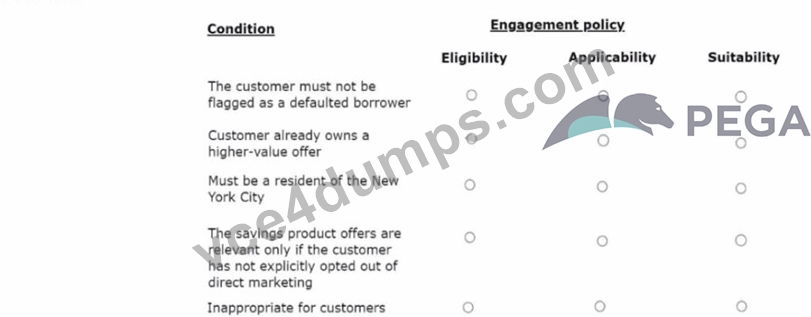
Answer:
Explanation: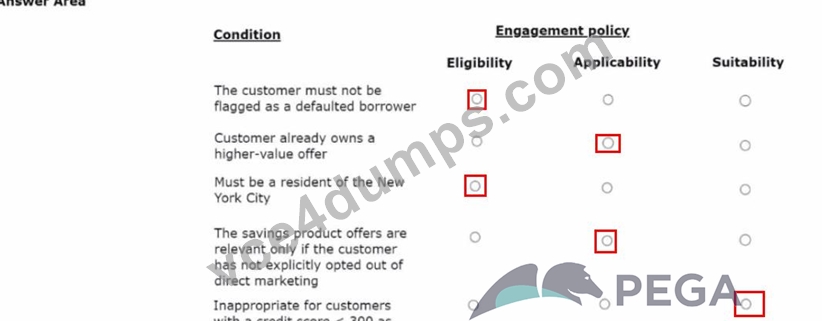
NEW QUESTION # 50
U+ Bank, a retail bank, is currently presenting a cashback offer on its website.
Currently, only the customers who satisfy the following engagement policy conditions receive the cashback offer:
While continuing cross-selling on the web, the bank now wants to present the cashback offer through a new channel, SMS. The bank also wants to update the suitability condition by lowering the threshold of the debt-to-income ratio from 48 to 45.
As a business user, what are the two tasks that you define to update the cashback offer? (Choose Two)
- A. Edit the engagement policy.
- B. Add a new treatment.
- C. Edit the action details.
- D. Edit an existing treatment.
- E. Remove existing treatment.
Answer: A,C
Explanation:
To update the cashback offer, you need to edit the engagement policy and the action details. Editing the engagement policy allows you to add a new channel (SMS) and update the suitability condition (lowering the debt-to-income ratio). Editing the action details allows you to specify the treatment for each channel (web and SMS). Verified Reference: [Pega Decisioning Consultant | Pega Academy]
NEW QUESTION # 51
You are a decisioning architect on a next-best-action project and are responsible for designing and implementing decision strategies. Select each component on the leftand drag it to the correct requirement on the right.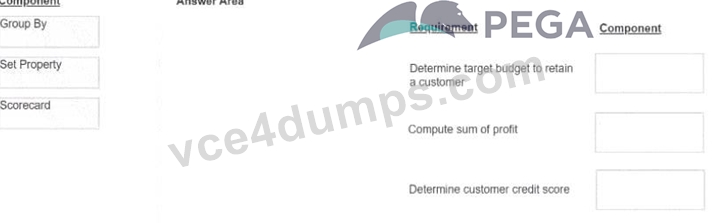
Answer:
Explanation: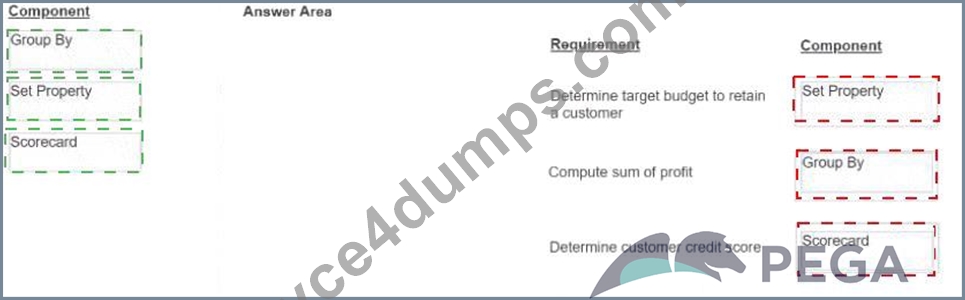
Explanation: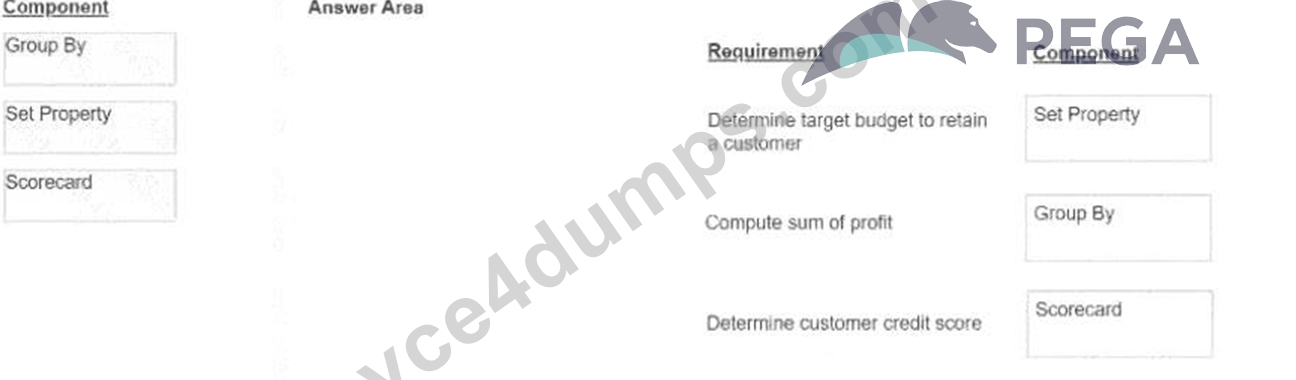
NEW QUESTION # 52
U+- Bank uses Pega Customer Decision Hub'" for their one-to-one customer engagement. The bank now wants to change its offer prioritization to consider both business objectives and customer needs.
Which two factors do you configure in the Next-Best-Action Designer to implement this change? (Choose Two)
- A. Context weighting
- B. Contact policies
- C. Business levers
- D. Engagement policies
Answer: A,C
NEW QUESTION # 53
Myco Bank, a retail bank, uses the Customer Engagement Blueprint to design personalized customer journeys. The bank wants to better understand its diverse customer base to create more targeted engagement strategies.
What key achievement does the Personas stage provide for Myco Bank when implementing with Customer Engagement Blueprint?
- A. Creating representative customer segments that enable targeted and personalized engagement strategies.
- B. Configuring the technical data structure required for personalized customer interactions.
- C. Defining the overall business objectives and strategic framework for customer engagement.
- D. Establishing consistent communication standards and visual identity across all customer touchpoints.
Answer: A
NEW QUESTION # 54
Acme Retail uses Pega Customer Decision Hub to present various offers to its customers. The company notices that some high-value customers are not receiving any offers. The marketing team wants to identify these underserved customers.
Which tool in Pega Customer Decision Hub can Acme Retail use to identify segments of customers who are not receiving relevant offers?
- A. CDH Assistant
- B. Application Overview
- C. Scenario Planner
- D. Value Finder
Answer: D
NEW QUESTION # 55
A financial institution has created a new policy that states the company will not send more than 500 emails per day. Which option allows you to implement the requirement?
- A. Outbound channel limits
- B. Suppression rules
- C. Applicability rules
- D. Volume constraints
Answer: D
Explanation:
Volume constraints allow you to limit the number of times an action is presented to customers across one or more channels. You can use volume constraints to implement a policy that restricts the number of emails sent per day. Outbound channel limits are used to limit the number of customers contacted per channel per run, not per day. Suppression rules are used to exclude customers from receiving an action based on certain conditions, such as opt-out preferences or recent purchases. Applicability rules are used to determine whether an action is relevant for a customer based on their profile or context, not based on the number of times the action is presented. Verified Reference: Certified Pega Decisioning Consultant | Pega Academy, Volume constraints
NEW QUESTION # 56
The U+ Bank marketing department wants to leverage the next-best-action capability of Pega Customer Decision Hub on Its website to promote new offers to each customer.
Place the events in the sequential order.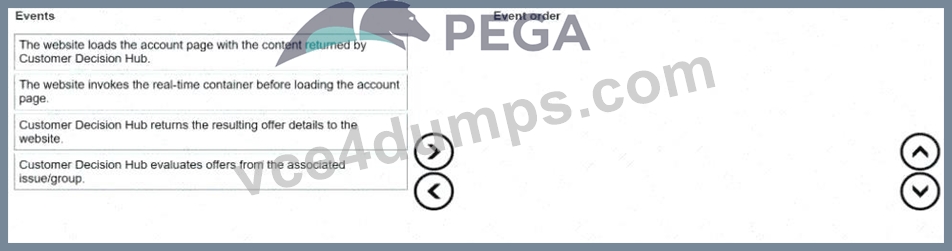
Answer:
Explanation: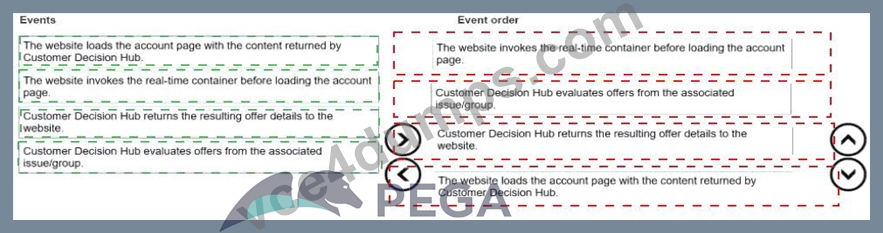
Explanation: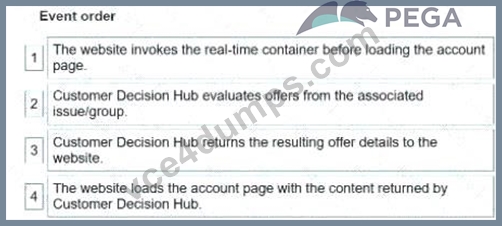
NEW QUESTION # 57
U+ Bank has recently implemented Pega Customer Decision Hub. As a first step, the bank went live with the contact center to improve customer engagement. Now, U+ Bank wants to extend its customer engagement through the web channel. As a decisioning architect, you have created the new set of actions, the corresponding treatments, and defined a new trigger in the Next-Best-Action Designer for the new web channel.
What else do you configure for the new treatments to be present in the next-best-action recommendations?
- A. Modify the Next-Best-Action Framework strategy to cater to the new web channel.
- B. No need to do anything. The strategy is auto-generated.
- C. Create a channel strategy specifically for web.
- D. Change the generated decision strategy.
Answer: B
Explanation:
When you create a new trigger in the Next-Best-Action Designer, Pega Customer Decision Hub automatically generates a decision strategy for that trigger and channel. You do not need to create or modify any strategies manually. Verified Reference: Pega Academy - Decisioning Consultant - Creating triggers
NEW QUESTION # 58
Pega Customer Decision Hub enables organizations to make Next-Best decisions. To which type of a decision is Next-Best-Action applied?
- A. Determining if a borrower gets a loan
- B. Optimizing supply chain management
- C. Determining how to optimize inventories
- D. Predicting the time of a machine failure
Answer: A
Explanation:
Next-Best-Action is a type of decision that involves selecting and prioritizing the most appropriate proposition for each customer at any given moment. Next-Best-Action can be applied to decisions that require customer-centricity, personalization, and contextualization. Determining if a borrower gets a loan is an example of such a decision, as it depends on the customer's attributes, behaviors, preferences, and needs. The other options are examples of decisions that are not related to customer interactions, but rather to operational or analytical processes. Verified Reference: [Pega Decisioning Consultant | Pega Academy]
NEW QUESTION # 59
U+ Bank decides to introduce a credit cards group by leveraging the Next-Best-Action capability of Pega Customer Decision Hub. The bank wants to present the credit card offers through inbound and outbound channels based on the following criteria:
1. Customers must be above the age of 18 to qualify for credit card offers.
2. The site offers credit cards only if customers do not explicitly opt-out of any direct marketing for credit cards.
3. The Platinum Card, one of the credit card offers, is suitable for customers with debt-to-income ratio < 45.As a decisioning architect, how do you implement this requirement? In the Answer Area, select the correct engagement policy for each criterion.
Answer:
Explanation:
A close-up of words AI-generated content may be incorrect.
NEW QUESTION # 60
......
Last PEGACPDC25V1 practice test reviews: Practice Test Pegasystems dumps: https://prep4sure.vce4dumps.com/PEGACPDC25V1-latest-dumps.html