


[2025] Pass 1z1-076 Exam - Real Questions and Answers
1z1-076 Exam Questions Get Updated [2025] with Correct Answers
Oracle 1z1-076 Exam Syllabus Topics:
| Topic | Details |
|---|---|
| Topic 1 |
|
| Topic 2 |
|
| Topic 3 |
|
| Topic 4 |
|
| Topic 5 |
|
| Topic 7 |
|
| Topic 8 |
|
NEW QUESTION # 16
Which TWO statements are true about Far Sync instances?
- A. They do not work with Logical Standby databases.
- B. They do not work with Snapshot Standby databases.
- C. They work in Maximum Protection mode.
- D. They work in Maximum Performance mode.
- E. They work in Maximum Availability mode.
Answer: A,D
NEW QUESTION # 17
Your Data Guard environment has two remote physical standby databases.
Client applications use the local naming method to connect to the primary database instance.
You want applications to automatically connect to the new primary database instance in case of a switchover or a failover.
Which set of actions will fulfill this requirement?
- A. Set DB_NAME and DB_UNIQUE_NAME identically on all databases; modify the connection descriptors on client applications to include all the standby hosts and connect to the database instance using that service name.
- B. Set the INSTANCE NAME parameter identically on all databases; modify the connection descriptor on client applications to include all the standby hosts and connect to the database instance using that service name.
- C. Set the LOCAL_LISTENER parameter for all the database instance to register services with the default listener on the primary database host.
- D. Create a database service on the primary database that is started automatically by a trigger, when the database role is PRIMARY; modify the connection descriptors used by client applications to include all the standby hosts and connect to the database instance using that service name.
Answer: D
Explanation:
For seamless client redirection in a Data Guard environment, the following steps should be taken:
Create a database service on the primary database that is started automatically by a trigger when the database role is PRIMARY (B): This ensures that the service is only available on the primary database and is automatically started after a role transition due to switchover or failover.
Modify the connection descriptors used by client applications to include all the standby hosts and connect to the database instance using that service name (B): Client applications use the connection descriptors that include all potential primary hosts (i.e., the current primary and all standbys). This enables clients to connect to whichever database is currently acting as the primary using the service name.
Reference:
Oracle Data Guard Concepts and Administration Guide
Oracle Real Application Clusters Administration and Deployment Guide
NEW QUESTION # 18
Which three statements are true....... With no Oracle Streams or Goldengate configured?
- A. The LGWR process writes to them on ....
- B. Only standby databases can write redo....
- C. They are required on a logical standby for real-time apply
- D. They are required only for synchronous redo transport
- E. They are required on a physical standby for real-time apply.
- F. It is recommended to have them on the...
Answer: A,C,E
Explanation:
C; The LGWR (Log Writer) process is responsible for writing redo entries from the redo log buffer to the online redo log files on the primary database. This is a fundamental process in the Oracle Database architecture, ensuring that all changes made to the database are captured for purposes such as recovery, replication, and high availability.
D; Real-time apply on a logical standby database requires standby redo log files. The standby redo log files are used to store redo data received from the primary database before it is applied to the logical standby database.
This enables the logical standby to apply changes as they are received, without waiting for the current redo log file to be archived.
E: Similarly, on a physical standby database, standby redo log files are used for real-time apply. They store redo data from the primary database, allowing the physical standby to apply redo data concurrently as it is received, rather than waiting for redo log files to be archived. This capability is crucial for maintaining a physical standby database that is closely synchronized with the primary database with minimal lag.
These functionalities are integral to Oracle Data Guard configurations and are not dependent on Oracle Streams or Oracle GoldenGate, which are separate technologies for data replication and integration.
NEW QUESTION # 19
You must configure an Oracle Data..........
1. A primary database
2. A physical standby database
Examine these requirements: 1. Data loss is not permitted.
1. Data loss is not permitted.
2. It should be possible to convert the physical standby database to a snapshot standby database.
3. Under normal operations, transactions should commit when redo is written to disk on the primary database and as soon as it has been received by the standby database instance.
4. The availability of the primary database should not be compromised by the availability of the standby database.
5. It should be possible to convert the physical standby database to a logical standby database
6. It should be possible to deploy Real Application Clusters on the primary database.
7. It should be possible to deploy Real Application Clusters on the physical standby database.
You configure SYNC redo transport mode in combination with Maximum Protection mode.
- A. 1, 2, 3, 6, and 7
- B. 1, 2, 6, and 7
- C. 1, 2, and 5
- D. 1, 2, 3, 4, 5, 6, and 7
- E. 1, 6, and 7
Answer: D
Explanation:
When SYNC redo transport mode is combined with Maximum Protection mode, it ensures that no data loss will occur (requirement 1). The physical standby can be converted to a snapshot standby (requirement 2) and later to a logical standby database (requirement 5), satisfying both transformation requirements. Transactions commit as soon as redo data is received by the standby database (requirement 3). The availability of the primary is not dependent on the standby database in Maximum Protection mode, as the primary database will halt if the standby cannot acknowledge the redo (requirement 4), thus indirectly ensuring its availability. It is also possible to deploy Real Application Clusters on both the primary (requirement 6) and the physical standby database (requirement 7), providing high availability and scalability.
ReferencesOracle Data Guard documentation detailing the requirements for different database roles, protection modes, and redo transport modes, as well as the capabilities and limitations of each configuration.
NEW QUESTION # 20
Which three are prerequisites for enabling Fast-Start Failover?
- A. Flashback Database must be enabled on both the primary database and the Fast-Start Failover target standby database.
- B. The configuration must be operating in either Maximum Performance or Maximum Protection mode.
- C. The Data Guard environment must be managed by the Data Guard Broker.
- D. The maximum protection mode can be used, but with two or more standby databases.
- E. Flashback Database must be enabled only on the Fast-Start Failover target standby database.
- F. You can specify only one standby database as the fast-start failover target.
Answer: A,C,F
Explanation:
To enable Fast-Start Failover in a Data Guard environment, the following conditions must be in place:
* The Data Guard environment must be managed by the Data Guard Broker (A): The Broker simplifies management tasks and is required to enable fast-start failover, which is an automatic failover mechanism provided by Data Guard.
* You can specify only one standby database as the fast-start failover target (C): Fast-start failover is designed to fail over to a single, predetermined standby database, known as the target standby.
* Flashback Database must be enabled on both the primary database and the Fast-Start Failover target standby database (F): Flashback Database provides a quick way to revert a database to a point
* in time before a logical or physical corruption or error occurred. It must be enabled on both the primary and target standby databases to allow for the possibility of reinstating the old primary as a standby after a failover.References:
* Oracle Data Guard Concepts and Administration Guide
* Oracle Database High Availability Overview
NEW QUESTION # 21
Examine the Data Guard configuration:
DGMGRL> show configuration;
Configuration - Animals
Protection Mode: MaxAvailability
Databases:
dogs - Primary database
sheep - Snapshot standby database
cats - Physical standby database
Fast-Start Failover: DISABLED
Configuration Status:
SUCCESS
You receive an error while attempting to raise the protection mode to Maximum Protection:
DGMGRL> edit configuration set protection mode as maxprotection;
Error: ORA-16627: operation disallowed since no standby databases would remain to support protection mode Failed.
Which is the minimum statement, or sequence of statements you must execute to enable successful raising of the protection mode to Maximum Protection?
- A. DGMGRL> edit database sheep set property LogXptMode=sync;
- B. DGMGRL> edit database cats set property LogXptMode=sync;
- C. DGMGRL> edit database dogs set property LogXptMode=sync;
DGMGRL> edit database sheep set property LogxptMode=sync;
DGMGRL> edit database cats set property LogXptMode=sync; - D. DGMGRL> edit database dogs set property LogxptMode=sync;
DGMGRL> edit database sheep set property LogxptMode=sync; - E. DGMGRL> edit database dogs set property LogxptMode=sync;
- F. DGMGRL> edit database dogs set property LogXptMode=sync;
DGMGRL> edit database cats set property LogXptMode=sync;
Answer: F
NEW QUESTION # 22
Which three are true regarding prerequisites for a logical standby database as a disaster recovery solution?
- A. Ensure that flashback is enabled on the primary database.
- B. Ensure that no BFILE LOB data types are contained in the primary database.
- C. Ensure that supplemental logging is enabled on the primary database.
- D. Do not perform any nologging operations on the primary.
- E. Ensure that no ROWID data types are contained in the primary database.
Answer: B,C,D
NEW QUESTION # 23
Which THREE statements are TRUE about the supported workload in Active Data Guard standby databases?
- A. You might have to use sequences with global temporary tables to support read-mostly applications by using Active Data Guard.
- B. PL/SQL blocks that you run on Active Data Guard standby databases can be always redirected to and run on the primary database.
- C. Read-mostly reporting applications that use global temporary tables for storing temporary data can be offloaded.
- D. The DML operations on a standby can be transparently redirected to and run on the primary database
- E. The DDL operations on private temporary tables are transparently redirected to the primary database.
Answer: A,C,D
Explanation:
In an Oracle Active Data Guard environment:
B: Read-mostly reporting applications that utilize global temporary tables to store session-specific data can be effectively offloaded to an Active Data Guard standby database, reducing the load on the primary database.
C: Sequences can be used with global temporary tables on an Active Data Guard standby database to support certain types of read-mostly applications, though some restrictions on sequence use may apply.
E: In Oracle Database 19c and later, DML redirection allows DML operations performed on an Active Data Guard standby database to be transparently redirected to the primary database. This is part of the DML Redirection feature.
Option A is incorrect because not all PL/SQL blocks run on an Active Data Guard standby database can be redirected to the primary database. Some PL/SQL executions, specifically those that would attempt to make changes to the database, are not supported on the standby.
Option D is incorrect because DDL operations on private temporary tables are not redirected; instead, private temporary tables are session-specific and are not persisted on disk, so they do not generate redo and are not applicable to an Active Data Guard standby.
NEW QUESTION # 24
Examine the following parameter settings of the physical standby database:
* STANDBY_FILE_MANAGEMENT=AUTO
* ENABLED_PDBS_ON_STANDBY=<null>
During which TWO tasks are files automatically created in the physical standby database after structure changes on the primary database?
- A. Creating a PDB from the existing PDB within the same CDB
- B. Performing transportable tablespaces
- C. Renaming a data file in the primary database
- D. Adding a data file or creating a tablespace
- E. Adding or dropping a redo file group
Answer: A,D
Explanation:
When STANDBY_FILE_MANAGEMENT is set to AUTO, the Oracle Data Guard automatically creates, deletes, and renames files on the standby database to match the changes made on the primary database. The tasks that lead to the automatic creation of files on the standby include:
Adding a data file or creating a tablespace (C): When a new tablespace is created or a new data file is added on the primary database, the standby database automatically replicates this action, maintaining structural consistency with the primary database.
Creating a PDB from the existing PDB within the same CDB (D): Creating a new Pluggable Database (PDB) within a Multitenant Container Database (CDB) on the primary database triggers an automatic creation of the corresponding PDB within the standby CDB.
Reference:
Oracle Data Guard Concepts and Administration Guide
NEW QUESTION # 25
Your Data Guard environment consists of these components and settings:
1. A primary database
2. A remote physical standby database
3. Real-time query is enabled.
4. The redo transport mode is set to SYNC.
5. The protection mode is set to Maximum Availability.
You notice that queries executed on the physical standby database receive errors: ORA-03172: STANDBY_MAX_DATA_DELAY of 15 seconds exceeded. Which two would you recommend to avoid this error?
- A. Increase the size of the buffer cache on the standby database instance.
- B. Change the protection mode to Maximum Protection.
- C. Reduce I/O latency for the storage used by the primary database.
- D. Increase the network bandwidth between the primary and standby databases.
- E. Change the protection mode to Maximum Performance.
- F. Increase the number of standby redo log files on the primary database.
Answer: C,D
Explanation:
The ORA-03172: STANDBY_MAX_DATA_DELAY error indicates that the real-time query on the physical standby database is experiencing delays beyond the specified maximum data delay threshold. Increasing the network bandwidth (Option E) can enhance the speed at which redo data is transferred from the primary to the standby database, thereby reducing the likelihood of exceeding the STANDBY_MAX_DATA_DELAY threshold. Reducing I/O latency on the primary database's storage (Option B) ensures that redo data is generated and shipped more efficiently, further mitigating the risk of delay. These actions, focused on optimizing data transfer and processing speed, address the root causes of the ORA-03172 error in a synchronous Data Guard configuration operating in Maximum Availability mode.
NEW QUESTION # 26
You have a Data Guard Broker configuration called 'Somewhere' as shown:
DGMGRL> SHOW CONFIGURATION;
Configuration - Somewhere
Protection Mode: MaxPerformance
Databases:
Nearby - Primary database
FS - Far Sync
Farout - Physical standby database
Fast-Start Failover: DISABLED
Configuration Status:
SUCCESS
You then run this command:
DGMGRL> SHOW DATABASE 'Nearby' 'InconsistentProperties';
Which two are true about the output of this DGMGRL command?
- A. It shows all properties whose broker configuration values for database Nearby are inconsistent with the values in the corresponding server parameter file or the runtime values for database instance Nearby.
- B. A far sync instance cannot have inconsistent properties because it has no database.
- C. Any inconsistency reported is on an instance-specific basis.
- D. It shows all properties whose broker configuration values for database Nearby are inconsistent with the broker configuration values for database Farout.
Answer: A,B
NEW QUESTION # 27
Which four requirements can be met by deploying a logical standby database?
- A. Support for workloads requiring additional materialized views.
- B. It must provide a disaster-recovery solution that protects all data with capability of performing switchovers and failovers.
- C. It can be used to create additional schemas.
- D. Support for workloads requiring additional indexes.
- E. It must have the same physical structure as the primary database.
- F. It can be used for Real Application Testing without affecting the disaster recovery capabilities.
- G. It can be used to create additional tables.
Answer: A,D,F,G
Explanation:
A logical standby database is part of Oracle Data Guard and allows the standby database to be open for read-write operations, providing additional flexibility. The requirements met by a logical standby database include:
Support for workloads requiring additional materialized views (A): Logical standby databases can support materialized views, allowing for complex data summarization and reporting workloads.
It can be used to create additional tables (C): Unlike physical standby databases, logical standby databases allow for the creation of additional tables that do not exist in the primary database, enabling custom workloads and reporting.
It can be used for Real Application Testing without affecting the disaster recovery capabilities (E): Logical standby databases can be used to test application changes, patches, and upgrades while still maintaining their role as part of the disaster recovery strategy.
Support for workloads requiring additional indexes (F): Logical standby databases allow for the creation of additional indexes to optimize query performance for reporting and analytical workloads.
Reference:
Oracle Data Guard Concepts and Administration
Oracle Database High Availability Overview
NEW QUESTION # 28
A customer asks for your recommendation regarding this requirement:
1. We plan to have a Data Guard Configuration with one primary database and one physical standby database.
2. We want zero data loss in case of a disaster involving the loss of one component.
3. We want to do Real Application Testing occasionally on the Standby Database.
Which solution, if any, satisfies these requirements?
- A. These requirements cannot be met.
- B. A far sync instance plus a snapshot standby database and real time apply that can be converted regularly into logical standby database to do real application testing
- C. A snapshot standby database with real time query that can be converted regularly into a physical standby database open read write, to do real application testing
- D. A physical standby database with synchronous redo transport that can be converted regularly into a snapshot standby to do real application testing
Answer: D
Explanation:
* Synchronous redo transport for zero data loss (B): To guarantee zero data loss in the case of a disaster, synchronous redo transport must be configured between the primary and standby databases.
* Conversion to snapshot standby for testing (B): A physical standby database can be temporarily converted into a snapshot standby database to perform real application testing. After testing is completed, the snapshot standby can be converted back to a physical standby to resume its disaster recovery role.
References:
* Oracle Data Guard Concepts and Administration Guide
* Oracle Database Testing Guide
NEW QUESTION # 29
Which two statements are true regarding asynchronous redo transport in a Data Guard
- A. This transport mode satisfies the minimum requirements for Maximum Performance data protection mode.
- B. A transaction can commit without waiting for redo to be sent to any standby database in the data guard configuration.
- C. This transport mode satisfies the minimum requirements for Maximum Availability data protection mode.
- D. The performance of SQL apply on a logical standby database always improves when using this transport mode.
- E. Real-time query performance on a physical standby database improves for current read requests when using this transport mode.
Answer: A,B
Explanation:
Asynchronous redo transport is a method where the primary database does not wait for an acknowledgment from the standby database before committing transactions, which helps in minimizing the impact on the primary database's performance (B). This transport mode is associated with the Maximum Performance data protection mode, which prioritizes performance over synchronicity of data between the primary and standby databases (C). While it provides a level of data protection, there could be some data loss in the event of a primary database failure because redo data may not have been transmitted to the standby database at the time of the failure.
References:Oracle Data Guard Concepts and Administration documentation provides detailed explanations of different redo transport modes and their implications on data protection and performance. Asynchronous transport mode's behavior and association with Maximum Performance mode are outlined explicitly.
NEW QUESTION # 30
You created a physical standby database prodsbyi from the primary database prod using SQL and RMAN. Which THREE are prerequisites for creating a Data Guard Broker configuration to manage these databases?
- A. A local net service name to enable connectivity to the PRODSBYI database instance must be defined on the primary database host.
- B. The primary database must have supplemental logging enabled.
- C. The primary database must have FORCE LOGGING enabled.
- D. The LOG_ARCHIVE_DEST_n parameters with the service attribute set must be cleared.
- E. The standby database must have supplemental logging enabled.
- F. The DG_BROKER_START parameter must be set to TRUE for both database instances.
Answer: A,B,F
Explanation:
When setting up a Data Guard Broker configuration for a primary database and its physical standby, the following prerequisites must be met:
A: Oracle Net connectivity must be defined on both the primary and standby hosts to enable the respective database instances to communicate with each other.
B: Supplemental logging is required on the primary database because it provides additional logging necessary for the standby database to be able to apply changes from the primary database accurately.
F: The DG_BROKER_START parameter must be set to TRUE for both the primary and standby database instances. This parameter is used to start the Data Guard Broker process which manages the configuration.
Options C and D are not prerequisites for creating a Data Guard Broker configuration. Additionally, while FORCE LOGGING mode (option E) is recommended as a best practice to prevent possible data inconsistencies during media recovery, it is not a strict prerequisite for creating a Data Guard Broker configuration.
NEW QUESTION # 31
Which two Data Guard features require the use of flashback database by the broker?
- A. Real Time Query
- B. Snapshot Standby databases
- C. Read-Mostly physical standby implementations
- D. Far Sync Instances
- E. Fast-Start Failover
Answer: B,E
NEW QUESTION # 32
There are currently 6 applief. and 6 pfepafef processes running and no idle applier processes on y logical standby database.
The max_SERVERS SQL apply parameter and number of archiver processes are both set to 12.
Identify two changes, each of which would allow you to increase the number of applier processes.
- A. Increase the value for the MAX_SERVERS SQL apply parameter.
- B. Increase the processes initialization parameter. D Decrease the number of FREPARER processes.
- C. Increase the RECOVERY_PARALLEL initialization parameter.
- D. Increase the parallel_max_server initialization parameter.
- E. Decrease the number of archiver processes on the standby database.
Answer: A,D
Explanation:
To increase the number of applier processes on a logical standby database, the following changes can be made:
C: Increasing the value for the MAX_SERVERS SQL apply parameter would allow for more applier processes to be initiated, assuming that system resources permit.
D: Increasing the PARALLEL_MAX_SERVERS initialization parameter would allow for more parallel execution processes, which can be used by SQL apply to increase the number of applier processes.
Option A is incorrect as decreasing the number of archiver processes will not necessarily increase the number of applier processes; these are unrelated components.
Option B is incorrect because the 'FREPARER' processes do not exist, it seems to be a typographical error, and the 'REPARER' is not a valid Oracle process or parameter.
Option E is incorrect because the RECOVERY_PARALLELISM parameter controls the number of processes used for instance recovery and media recovery, not for SQL apply.
NEW QUESTION # 33
Which two statements are true when using non-rolling release upgrades in a Data Guard environment?
- A. During the upgrade of a logical standby database, standby redo log files must reside on O/S file systems.
- B. User equivalence must be established for the owner of the Oracle software on the affected hosts prior to the upgrade.
- C. Modifications to the data dictionary on the primary database caused by the upgrade, are applied on a physical standby database.
- D. The compatible parameter on a standby database that is applying redo, must be equal to or greater than the compatible parameter on the primary that is shipping redo to that standby.
- E. Modifications to the data dictionary on the primary database caused by the upgrade, are applied on a logical standby database.
Answer: C,D
Explanation:
The compatible parameter on a standby database that is applying redo, must be equal to or greater than the compatible parameter on the primary that is shipping redo to that standby (A): This ensures that the standby database can apply redo from the primary, even after the primary has been upgraded. The COMPATIBLE parameter setting on the standby database should not preclude it from understanding the redo it receives.
Modifications to the data dictionary on the primary database caused by the upgrade, are applied on a physical standby database (C): When the primary database undergoes a non-rolling upgrade, any resulting data dictionary changes are transmitted through redo data and applied to the physical standby database.
Reference:
Oracle Database Upgrade Guide
Oracle Data Guard Concepts and Administration Guide
NEW QUESTION # 34
You created a physical standby database prodsbyi from the primary database prod using SQL and RMAN.
Which THREE are prerequisites for creating a Data Guard Broker configuration to manage these databases?
- A. A local net service name to enable connectivity to the PRODSBYI database instance must be defined on the primary database host.
- B. The primary database must have supplemental logging enabled.
- C. The primary database must have FORCE LOGGING enabled.
- D. The LOG_ARCHIVE_DEST_n parameters with the service attribute set must be cleared.
- E. The standby database must have supplemental logging enabled.
- F. The DG_BROKER_START parameter must be set to TRUE for both database instances.
Answer: A,B,F
Explanation:
When setting up a Data Guard Broker configuration for a primary database and its physical standby, the following prerequisites must be met:
* A: Oracle Net connectivity must be defined on both the primary and standby hosts to enable the respective database instances to communicate with each other.
* B: Supplemental logging is required on the primary database because it provides additional logging necessary for the standby database to be able to apply changes from the primary database accurately.
* F: The DG_BROKER_START parameter must be set to TRUE for both the primary and standby
* database instances. This parameter is used to start the Data Guard Broker process which manages the configuration.
Options C and D are not prerequisites for creating a Data Guard Broker configuration. Additionally, while FORCE LOGGING mode (option E) is recommended as a best practice to prevent possible data inconsistencies during media recovery, it is not a strict prerequisite for creating a Data Guard Broker configuration.
References: This guidance is based on Oracle's best practices for setting up Data Guard configurations, as found in the Oracle Data Guard Broker documentation and the Oracle Data Guard Concepts and Administration guide.
NEW QUESTION # 35
Which THREE statements are TRUE about Global Sequences when connected to a physical standby database with Real-Time Query enabled?
- A. If the CACHE option is set then the size of the cache must be at least 100.
- B. Their creation requires that a LOG archive_dest_n parameter be defined in the standby that points back to the primary.
- C. They must have the NOORDEK and CACHE options set.
- D. Their usage may have a performance impact on the physical standby database if the CACHE size is too small.
- E. Their usage will always have a performance impact on the primary database.
Answer: C,D,E
Explanation:
Global Sequences are Oracle sequences that generate unique values across multiple instances in an Oracle RAC or a Data Guard configuration. Regarding their behavior and performance when connected to a physical standby database with Real-Time Query enabled:
A: The usage of Global Sequences can indeed have a performance impact on the primary database due to the need to generate unique values that are consistent across both primary and standby databases.
D: The performance impact on the physical standby database may occur if the CACHE size is too small. This is because the standby database will frequently have to access the primary database to replenish the cache, which can increase the load and potentially lead to performance degradation.
E: Global Sequences should have the NOORDER and CACHE options set. The NOORDER option ensures that sequence numbers are provided without guaranteeing sequence order, thus improving scalability and performance. The CACHE option is used to specify how many sequence values will be held in memory for faster access.
Option B is incorrect as the LOG_ARCHIVE_DEST_n parameter's definition for standbys pointing back to the primary does not directly pertain to the creation of sequences.
Option C is incorrect because there is no requirement that the size of the cache for a sequence must be at least 100. The CACHE size can be set to a different number based on specific use cases or performance considerations.
NEW QUESTION # 36
Active Data Guard (ADG) databases are widely used to offload reporting or ad hoc query-only jobs from the primary database. Reporting workload profile is different from the primary database and often requires tuning.
Which tool is used to tune SQL workloads running on an ADG database?
- A. Automatic Diagnostic Database Monitor (ADDM)
- B. In-Memory Active Session History (ASH)
- C. SQL Tuning Advisor
- D. Automatic Workload Repository (AWR)
- E. Standby Statspack
Answer: D
Explanation:
AWR collects, processes, and maintains performance statistics for problem detection and self-tuning purposes. In an Active Data Guard environment, where the physical standby database can be used for read-only workloads, AWR can be instrumental in identifying performance bottlenecks and areas for optimization. It provides detailed reports that include wait events, time model statistics, and active session history, making it an invaluable tool for tuning SQL queries and overall database performance in an ADG setup.
NEW QUESTION # 37
Examine the fast-start failover configuration: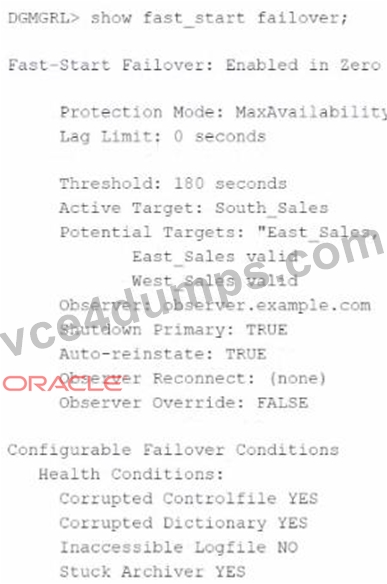
- A. A failover may occur if the observer has lost connectivity to the primary database, even if the Fast-Start Failover target standby database has a good connection to the primary database
- B. If South_Sales develops a problem and cannot be the target of a failover, the broker automatically changes the fast-start failover target to one of the other candidate targets.
- C. The observer is running.
- D. The observer will initiate a failover when the primary database is unable to produce local archived redo log files.
- E. You must disable fast-start failover first to change the fast-start failover target to East sales.
Answer: A,C,D
NEW QUESTION # 38
Which two statements are true regarding Data Guard environments in an Oracle Muti-tenant architecture?
- A. The Data Guard broker may be used for multi-tenant databases.
- B. PDB_FILE_NAME CONVERT must be set to enable creation of standby databases if they are created on the same host as the primary.
- C. A Data Guard environment with a multi-tenant primary database can operate in any Protection mode.
- D. Different redo transport methods can be configured for different pluggable databases within one Data Guard environment.
- E. Standby redo log files are required for each pluggable database that is protected with Data Guard.
Answer: A,C
Explanation:
Oracle Multi-tenant architecture and Data Guard have several interactions, but specific aspects hold true in such environments:
* The Data Guard broker may be used for multi-tenant databases (B): Data Guard Broker simplifies the management and monitoring of Data Guard configurations and is fully compatible with the Oracle Multi-tenant architecture, allowing for easy management of Data Guard configurations that include multi-tenant container databases (CDBs) and their pluggable databases (PDBs).
* A Data Guard environment with a multi-tenant primary database can operate in any Protection mode (E): Data Guard can be configured to operate in Maximum Performance, Maximum Availability, or Maximum Protection mode, regardless of whether the primary database is a multi-tenant database.
This flexibility ensures that Data Guard can meet various data protection and availability requirements in multi-tenant environments.References:
* Oracle Data Guard Broker documentation
* Oracle Multitenant Administrator's Guide
NEW QUESTION # 39
......
Practice 1z1-076 Questions With Certification guide Q&A from Training Expert VCE4Dumps: https://prep4sure.vce4dumps.com/1z1-076-latest-dumps.html